It usually happens at an inconvenient moment. You press the button, the opener strains and lifts the door six inches, and then it stops or drops back. Or you are in the kitchen and hear what sounds like something heavy falling off a shelf in the garage.
That sound is a spring breaking. We replace broken garage door springs for homeowners in Nashotah and the neighboring communities, and we would like you to know what has happened and what to do next before you touch anything.
First, what to do right now
- Leave the door closed if it is closed. It is at its safest sitting on the floor.
- Stop pressing the opener button. The motor is not built to lift the full weight of the door and can burn out or strip its gear.
- Do not pull the red emergency release if the door is partly or fully open. Without a spring, the door can drop with its full weight.
- Keep children, pets and vehicles away from the door.
- Do not loosen any bolts on the spring assembly, the cables or the brackets at the bottom corners of the door.
- If a car is trapped inside and you must get out, call us first. We can advise on whether the door can be raised safely and how.
A two-car insulated door can weigh 200 pounds or more. With the spring broken, you would be lifting all of it, and nothing would hold it up once it was raised.
How to tell a spring has broken
The signs are usually clear.
- A visible gap. Look at the spring on the shaft above the door. A broken torsion spring has a gap of an inch or two where the coil has separated.
- A hanging spring or loose cable. Extension springs run along the horizontal track on each side. A broken one hangs limp, often with its pulley and cable dangling.
- The door is extremely heavy. If the opener is disconnected and you cannot raise the door more than a few inches, the spring is not carrying it.
- The door lifts a little and stops. Many openers sense the overload and shut down or reverse.
- The door is crooked. With two extension springs, one broken spring leaves one side unsupported.
- Loose cables. Lift cables that have gone slack or come off their drums often accompany a spring failure.
Why springs break
Springs are wear items. They are designed to fail eventually, and they are replaced, not repaired.
Metal fatigue
Every time the door opens and closes, the spring winds and unwinds. A standard spring is rated for roughly 10,000 of those cycles. Four cycles a day gets you there in about seven years. A busy family can do it sooner.
Cold
Steel becomes less ductile as the temperature drops. A spring that is nearly worn out will often choose the first hard cold snap of the year to let go, which is why our phones are busiest on January mornings.
Rust
Corrosion pits the surface and adds friction between coils. Garages near the lakes, and any garage where wet, salty cars are parked all winter, are harder on springs.
Wrong size
A spring that is too light for the door works at the limit of its range on every cycle and fatigues quickly. This is more common than you would think after a previous quick repair.
No maintenance
A light coat of lubricant once or twice a year reduces coil friction and keeps moisture off the steel. Most springs never get any.
The two kinds of spring
Torsion springs
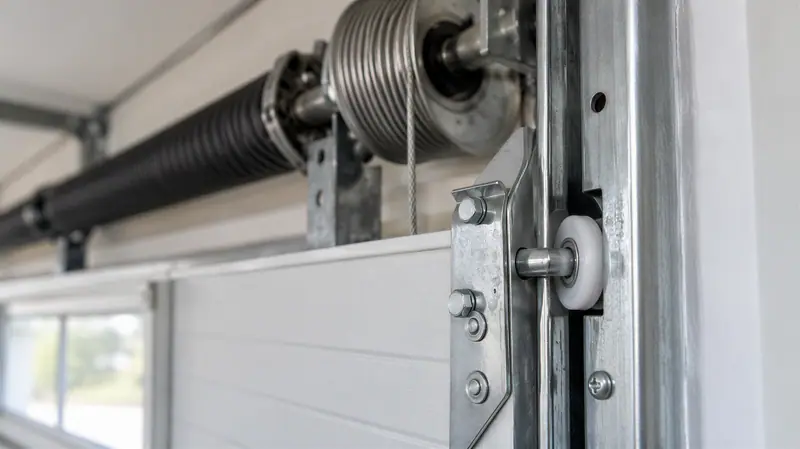
Mounted on a steel shaft across the top of the opening. They twist to store energy and lift the door through cables wound on drums at each end. Standard on most modern doors. More on the torsion spring replacement page.
Extension springs
Long springs stretched along the horizontal tracks on both sides. They pull through pulleys and cables. Common on older and lighter doors. More on the extension spring replacement page.
We replace both. On many extension-spring doors, converting to a torsion system is worth considering while the work is being done, and we will explain the option if it applies to yours.
How we replace a broken spring
- 01
Secure the door
The door is clamped to the track so it cannot move, and the opener is disconnected.
- 02
Release any remaining tension
On a two-spring system the unbroken spring is still fully wound. We unwind it under control with steel winding bars.
- 03
Weigh and measure
We confirm the door's weight and measure the old springs so the replacements are right for the door as it is today, not as it was specified years ago.
- 04
Fit new springs
New springs, and new cones or fittings as needed, go onto the shaft or track. We replace springs in pairs.
- 05
Inspect the rest
Cables, drums, bearings, bottom brackets and rollers are checked, because a spring failure often shocks or loads the parts around it.
- 06
Wind and balance
The springs are wound to the correct turns and the door is tested by hand at several heights. It should stay where it is put.
- 07
Reset the opener and test
The opener is reconnected, travel and force are checked, and the safety reversal is tested.
For most residential doors this is done in a single visit, typically in about an hour.
Before & after
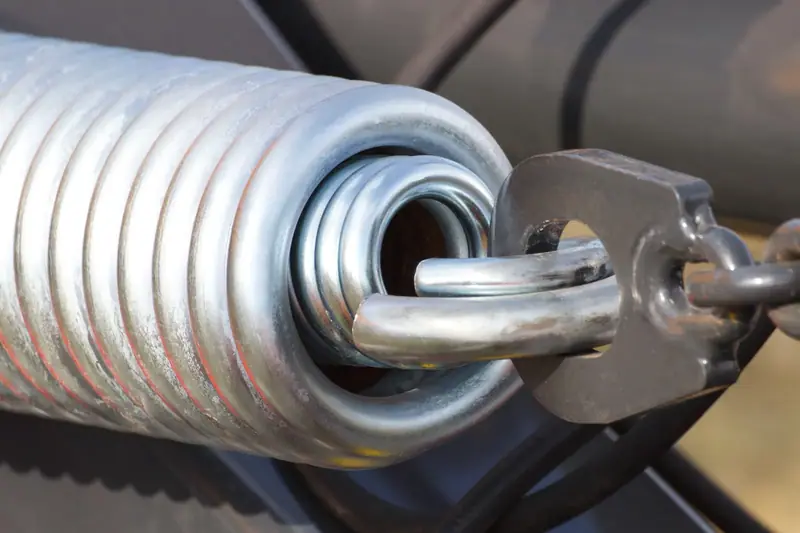
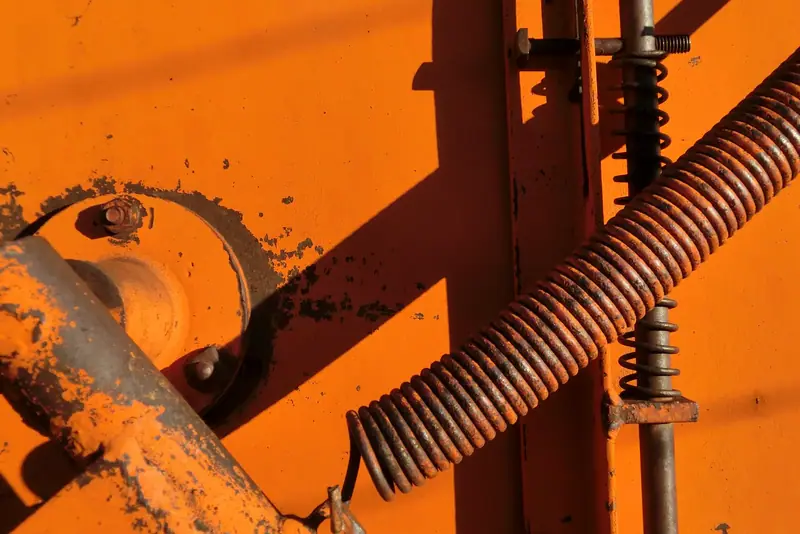
A rusted, failing spring compared with a correctly sized replacement
Project notes
The first image shows a spring that has been living in a damp garage: rust across the coils, pitting where moisture has sat, and the dull, dry look of steel that has not seen lubricant in years. Rust matters on a spring because every pit is a point where a crack can start, and because rough coils grind against each other on every cycle.
The second image illustrates what goes on in its place. A new spring is chosen by wire size, inside diameter and length to match the door's measured weight, then installed with new end fittings and wound to the correct number of turns. We lubricate it lightly so the coils slide freely.
After a correct spring replacement the door lifts easily by hand, stays put when stopped halfway and comes down under control. The opener goes back to guiding the door instead of dragging it.
Illustrative example. These are licensed reference photographs chosen to show the kind of change this service makes. They are not photos of a specific Nashotah Garage Door customer's property.
Why we replace both springs
On a door with two springs, both were installed on the same day and have done exactly the same work. When one breaks, the other is at the end of its life too. Replacing only the broken one leaves a new spring and a worn spring sharing the load unevenly, and it guarantees a second visit before long. Doing both at once restores proper balance and costs less overall.
Choosing a longer-lasting spring
When a spring is being replaced anyway, you have a choice about its cycle life.
| Spring rating | Approximate life at 4 cycles a day | Who it suits |
|---|---|---|
| Standard, about 10,000 cycles | Around 7 years | Lightly used doors, short-term ownership |
| Mid-range, about 20,000 to 25,000 cycles | Around 14 to 17 years | Most households using the garage as the main entrance |
| High-cycle, 30,000 cycles and up | 20 years or more | Busy families, heavy doors, anyone who dislikes repeat repairs |
A longer-life spring is physically larger, using more steel to do the same job with less stress. The extra cost is usually modest compared with a second replacement. We also offer galvanized or coated springs for damp garages, which resist rust better than bare oil-tempered steel.
Why this is not a do-it-yourself repair
We say this on several pages because it matters. A wound torsion spring stores enough energy to throw a steel winding bar across the garage. The common injuries are broken fingers, wrists and facial bones, and worse has happened. Online videos make it look routine because the people in them have done it thousands of times with proper bars and a set procedure.
There is also the question of getting the right spring. Springs are not sold by door size. They are specified by wire diameter, inside diameter, length and wind direction to match a particular door weight and drum. Two doors of the same dimensions can need quite different springs. A near miss leaves the door too heavy or too lively, and both conditions wear out the opener.
Spring problems and Nashotah winters
A few local observations.
Cold-morning failures cluster after the first week of real winter. If your springs are original and the door is seven or more years old, having them checked in the fall is cheap insurance.
Detached and lakeside garages see more condensation, and their springs rust sooner. A coated spring and a twice-yearly spray of lubricant make a marked difference.
After a spring is replaced, the door may feel slightly different in deep cold than it did on the day of installation, because steel stiffens as it cools. We allow for that when we balance the door, and we are glad to make a seasonal adjustment if you notice a change.
Frequently asked questions
It is possible on some doors with two strong adults, but it is risky and we do not recommend it. The door will be very heavy and will not stay up on its own. Call us first and we will advise.
Usually around an hour for a standard residential door once we are on site.
Yes. The second spring has done the same number of cycles and will fail soon. Replacing the pair keeps the door balanced.
It depends on the spring size, type and cycle rating your door needs. We give you the price before any work begins.
Sometimes. If the button was pressed repeatedly after the spring broke, the drive gear or trolley can be stripped. We check the opener as part of the visit and tell you what we find.
Choose a higher cycle rating, keep them lightly lubricated, and have the door's balance checked once a year.