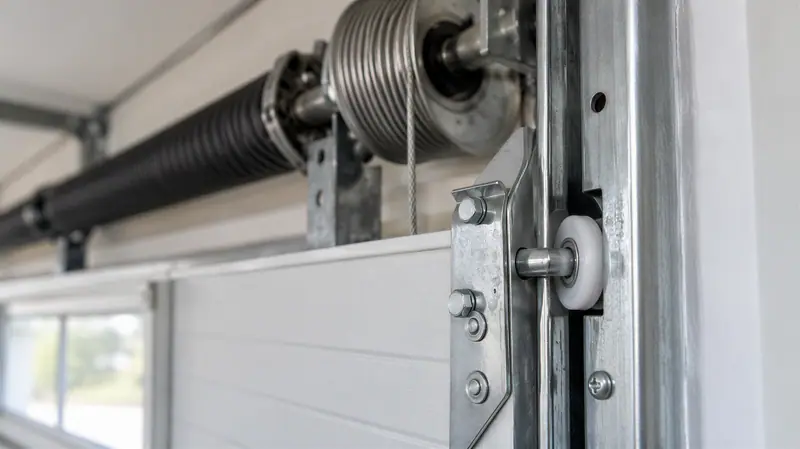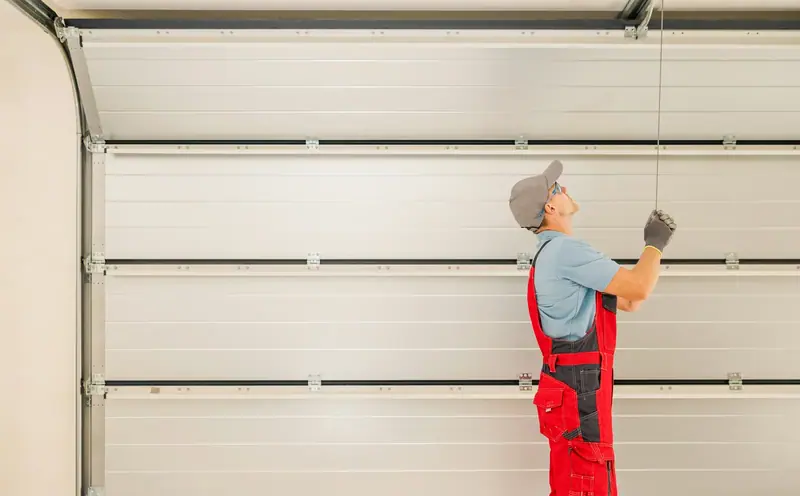
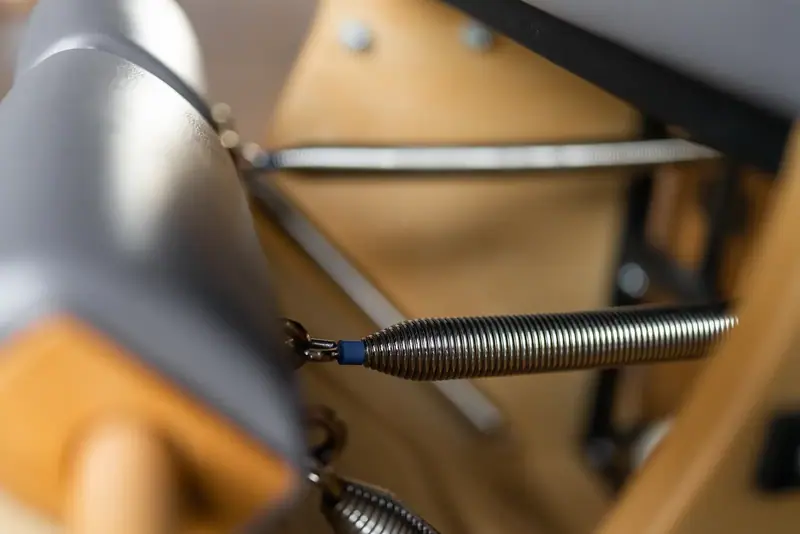
If your garage door has a long spring running parallel to each horizontal track, above head height on both sides, it uses extension springs. They are common on older homes, on lighter single doors, and in garages where there is not enough room above the opening for a torsion shaft.
Many detached garages and older cottages around Nashotah still have them. We replace extension springs regularly, and we take the safety side of the job seriously.
How extension springs work
A torsion spring twists. An extension spring stretches.
When the door is closed, each spring is pulled out to its longest length and is under full tension. A cable runs from the bottom corner of the door, up over a fixed pulley near the top of the opening, back through a second pulley attached to the end of the spring, and then to an adjustable anchor on the track hanger. As the door opens, the springs contract and pull the cables, lifting the door. As it closes, the weight of the door stretches them out again.
Because each side has its own spring, pulley and cable, the two sides have to be matched closely. If one spring is weaker than the other, the door lifts crooked.
The parts of the system
Extension springs
One on each side. Color coded at the end by the door weight they are made to lift.
Stationary pulleys
Mounted on the flag bracket or header at each top corner. The lift cable passes over them.
Spring pulleys
Attached to the moving end of each spring by a fork or clevis.
Lift cables
Run from the bottom brackets through both pulleys to the anchor point.
Safety cables
A separate cable threaded through the middle of each spring and fixed at both ends. Its only job is to contain a broken spring.
Adjustment hardware
An S-hook and a plate with a row of holes, used to fine-tune cable length and tension on each side.
When extension springs need replacing
A complete break is hard to miss. The spring hangs slack, the cable drops, and that side of the door will not lift. But these springs usually give warning first.
- Gaps between the coils when the door is open and the spring is relaxed. A healthy spring closes up tight. One that has been overstretched stays slightly open.
- A door that rises unevenly, with one side lagging.
- The door will not stay halfway. With the opener released, it drops instead of holding.
- Rust or deformed end loops. The loops are the weak point and often fail before the body of the spring.
- Squealing pulleys or pulleys that wobble on their bolts.
- A door that seems heavier each winter.
If you notice any of these, keep clear of the springs and have them looked at.
Safety cables: the part that must not be skipped
When a torsion spring breaks, it stays on its shaft. When an extension spring breaks, it is free at one end and carries a great deal of stored energy. Without anything to hold it, the spring and its pulley can fly the length of the garage. Cars, windows and people have all been struck.
A safety cable prevents that. It runs straight through the center of the spring from the rear hanger to the front bracket. If the spring breaks, it stays strung on the cable.
Many older doors were installed without them, or have lost them during a past repair. We fit safety cables on every extension spring job. If your door has extension springs and you cannot see a cable running through the middle of each one, that alone is a reason to call.
How we replace extension springs
- 01
Open and secure the door
Extension springs are under the least tension with the door fully open. We raise the door, clamp the tracks beneath the bottom rollers and disconnect the opener.
- 02
Remove the old springs and cables
Safety cables, spring pulleys and the springs themselves come off both sides.
- 03
Check the door weight
We confirm the weight so the new pair is correctly rated, instead of relying on the color of the old ones.
- 04
Inspect pulleys and lift cables
Pulleys with rough bearings, worn grooves or elongated bolt holes are replaced. Frayed cables are replaced.
- 05
Install matched springs
A new pair of identical springs goes on, with the end loops properly seated.
- 06
Thread and anchor safety cables
A containment cable is run through each spring and fixed securely at both ends.
- 07
Set the cable tension
The adjustment on each side is set so both cables are equally taut with the door open.
- 08
Lower and test the balance
The door is brought down and tested by hand at several heights, then the opener is reconnected and checked.
Always in pairs. Replacing one extension spring leaves a new spring on one side and a tired one on the other, and the door will pull to one side from the first cycle.
Before & after
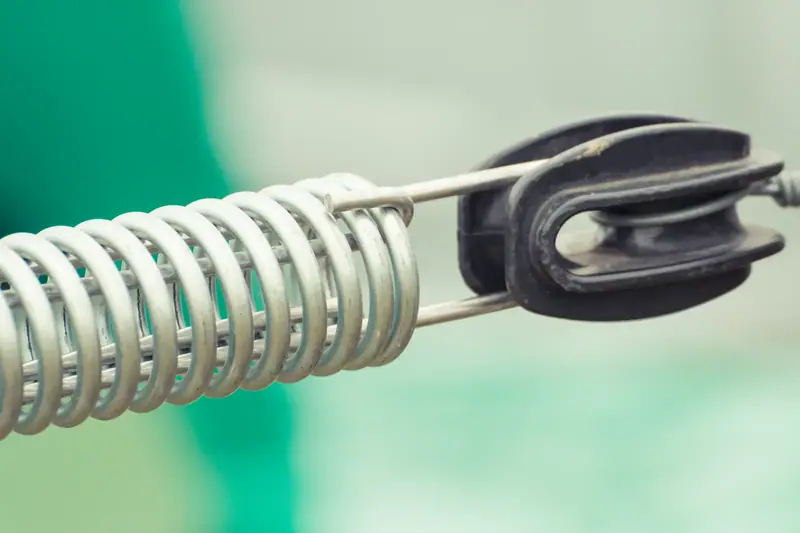
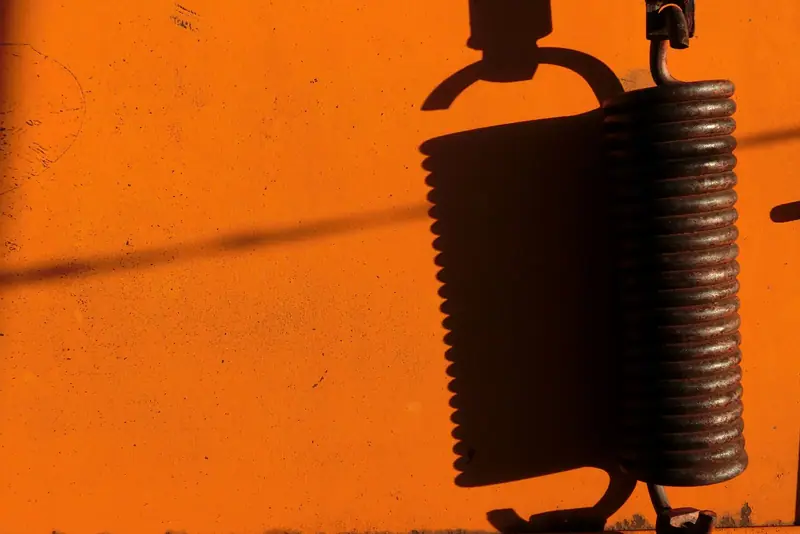
A rusted extension spring compared with a new spring and pulley
Project notes
The spring in the first image has been stretched and released for many years in a damp space. Rust has taken hold across the coils and at the end loops, which is exactly where extension springs tend to let go. A spring in this condition has lost pull, and the door will feel heavy and may hang unevenly.
The illustrated replacement shows a new spring with its end properly formed and attached to a new pulley. In practice both springs are replaced together, along with the pulleys if their bearings are worn, and a containment cable is threaded through the center of each spring and anchored at both ends.
The door lifts evenly again, both sides rise at the same rate, and if a spring ever does break, the safety cable holds it in place instead of letting it whip across the garage.
Illustrative example. These are licensed reference photographs chosen to show the kind of change this service makes. They are not photos of a specific Nashotah Garage Door customer's property.
Extension or torsion: should you convert?
This comes up on most extension spring visits, so here is a plain comparison.
| Extension springs | Torsion springs | |
|---|---|---|
| Movement | Stretch and contract along the track | Twist on a shaft above the door |
| Balance | Each side independent, harder to keep even | Both sides driven by one shaft, naturally even |
| Smoothness | Can be slightly jerky | Smooth and controlled |
| Typical life | Shorter, with more moving parts to wear | Longer, with high-cycle options |
| If a spring breaks | Needs a safety cable to contain it | Stays on the shaft |
| Space required | Very little headroom | Roughly a foot above the opening, less with special hardware |
| Cost to replace | Lower | Higher |
Our advice is usually this. If the door is light, the garage has low headroom and the system is in decent order, new extension springs with safety cables are a perfectly sound repair. If the door is a heavy double, is used many times a day, or the pulleys, cables and hangers are all worn, converting to torsion is worth the extra cost because you are replacing most of the hardware anyway. We will measure the headroom and tell you whether a conversion is possible in your garage.
What Wisconsin weather does to extension springs
Extension springs live out in the open along the tracks, and the climate gets at them.
Rust at the loops. Condensation settles on cold steel whenever a warm, wet car pulls in. The end loops and the first few coils rust first. In unheated garages near the lakes this is the usual cause of failure.
Cold and lost pull. Like all springs, they lift a little less when very cold. A door that was marginal in October may not stay open in January.
Pulleys and grit. Road salt and sand get into pulley bearings. A seized pulley makes the cable slide instead of roll, which wears through it surprisingly fast.
Seasonal buildings. Garages at lake properties that sit closed for months tend to have springs and cables that have rusted without anyone noticing. A check when you open up for the season is worthwhile.
A light spray of garage door lubricant on the springs and pulley bearings each fall helps with all of this.
Why not do it yourself?
Extension springs have a reputation for being the easier, safer type to replace because the work is done with the door open and the springs relaxed. That is partly true, and it is also where people come unstuck.
The door has to be held open securely the whole time. If a clamp slips with the springs off, the full weight of the door comes down. Choosing the right spring by weight, not by guesswork or by the faded paint on the old one, takes a proper check. Routing the lift cable and the safety cable correctly through both pulleys is easy to get wrong, and a misrouted cable will fray or jump off. And balancing the two sides evenly is fiddly work that determines whether the door runs straight.
It is a modest repair in our hands, and we would much rather do it than hear about it afterward.
Frequently asked questions
Typically around 10,000 cycles, similar to a standard torsion spring, though rust and worn pulleys often end their life earlier.
Yes. They work as a pair and must match. Replacing one leaves the door unbalanced from side to side.
They indicate the door weight the spring is rated for. The paint fades and previous repairs are not always correct, so we verify the door weight directly.
Yes. Without a safety cable, a broken spring can be thrown across the garage. We fit safety cables on every job, and can add them to existing springs that are otherwise sound.
Usually, if there is enough headroom above the opening. We will measure and let you know, and price both options.
With extension springs, that usually means one spring is weaker, a cable has stretched or slipped, or a pulley is binding. It should be corrected before the door jams or comes off its track.