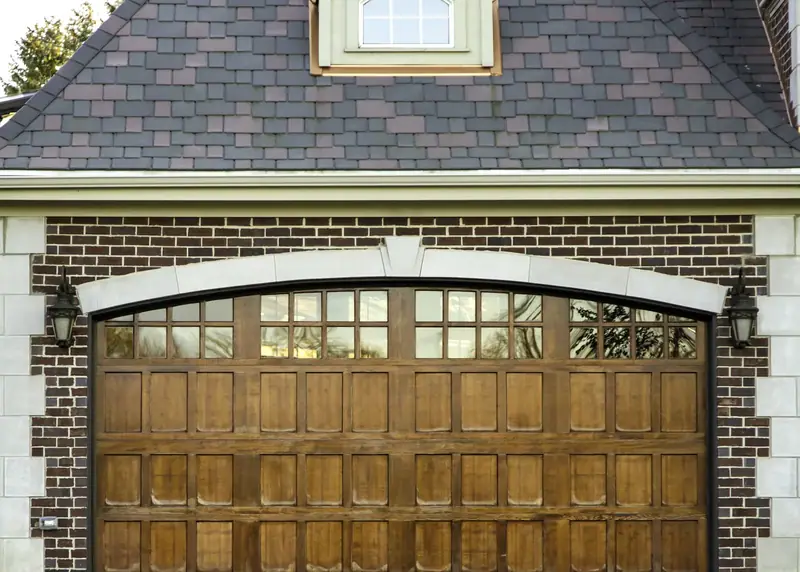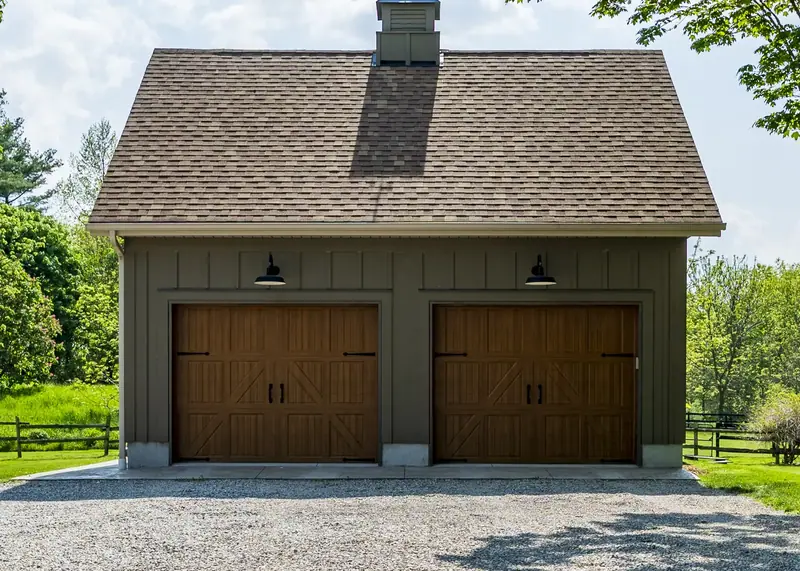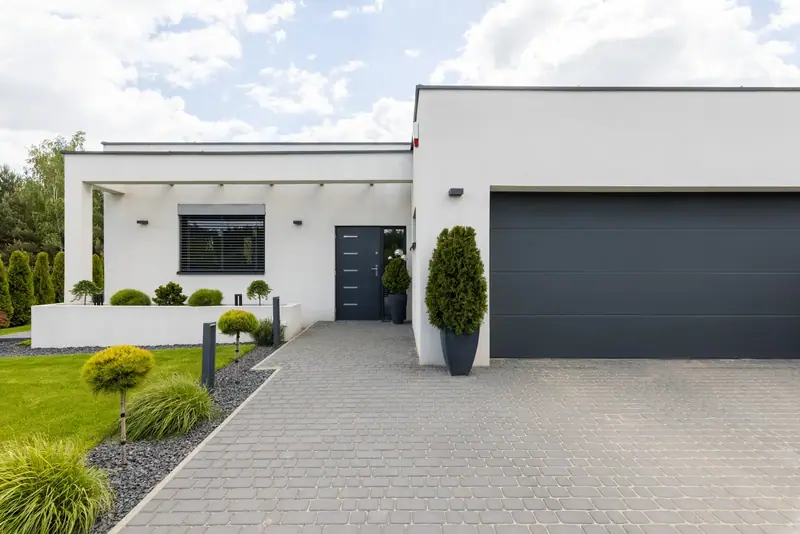
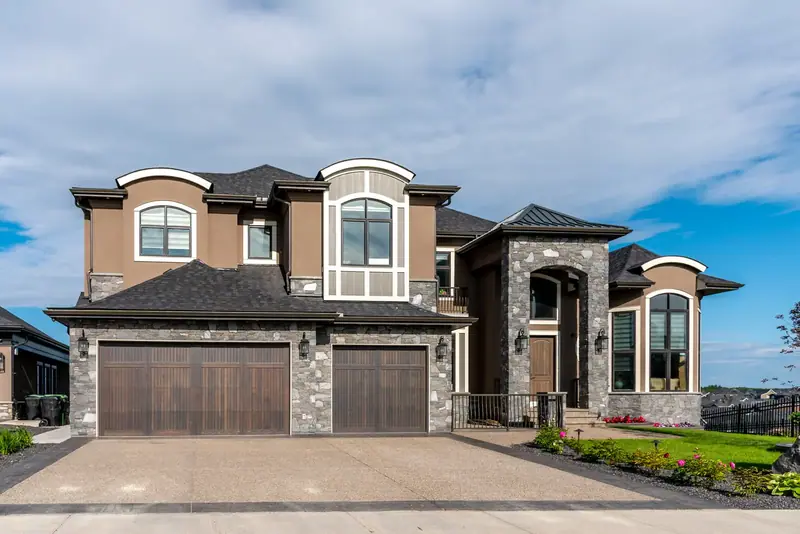
A well-made wood garage door has a quality you notice from the end of the driveway. The grain catches the light. The color has depth. The joinery throws real shadows. Faux finishes have become very good, and they still are not quite the same thing.
We supply and install custom wood garage doors for homes around Nashotah, many of them on lake properties where the garage is a prominent part of the approach. We also believe in telling people the whole story about wood before they order it.
The honest case for and against wood
| What you gain | What it asks of you |
|---|---|
| Natural grain and warmth that no print can fully copy | A finish that must be inspected yearly and renewed every few years |
| Complete freedom of design, size and detail | A higher initial cost than steel or composite |
| The ability to repair, refinish and restore indefinitely | Sensitivity to moisture, sun and neglect |
| A door that can be matched to beams, trim and entry doors | More weight, and hardware sized to carry it |
If the left-hand column matters to you and the right-hand one does not put you off, wood is a wonderful choice. If you know you will not keep up with the finish, we will show you a wood-look alternative and think no less of you.
Species we commonly work with
Western red cedar
Light, stable and naturally resistant to decay. Takes stain beautifully. Soft, so it marks more easily. The most popular choice.
Douglas fir
Straight-grained and strong, with a warm reddish tone. Good for painted or stained doors. Needs a reliable finish.
Mahogany and sapele
Dense, durable hardwoods with a rich, even color. Excellent stability and a premium look, at a premium price.
Hemlock
Fine, even texture that paints and stains well. A good value for sheltered positions.
Redwood
Stable and decay resistant with a deep color. Availability and price vary.
Knotty alder and rustic grades
Chosen for character, with knots and color variation. Suits lodge and rustic styles.
Reclaimed timber can be used as a facing on some doors, and it gives a look nothing else can. It has to be sound and dry, and we assess it case by case.
How wood doors are constructed
There are three broad approaches, and the difference matters for weight, stability and insulation.
Solid stile-and-rail
Built like a traditional house door, with solid frame members and floating panels. Authentic and repairable. The heaviest option and the one that moves most with humidity.
Wood over an insulated core
A structural frame with a foam core, faced on the outside with wood boards or veneer panels. Lighter, flatter and warmer than solid construction, and by far the most common choice for an attached garage in this climate.
Wood overlay on steel
An insulated steel door with real wood boards applied to the face. Combines a steel door's stability and insulation with a genuine timber surface.
In each case the door is made in horizontal sections that hinge and roll overhead, even when the face is designed to look like swinging or sliding doors.
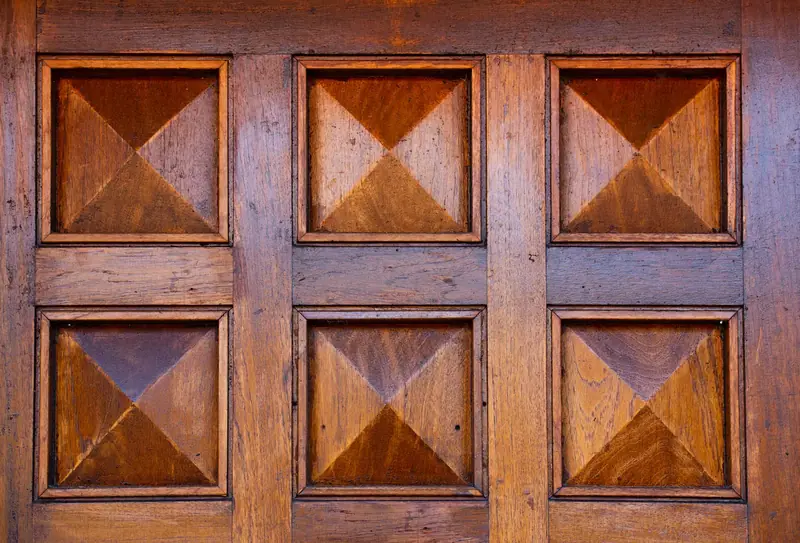
Design options
Because wood doors are built to order, the design is open. The common directions are:
- Carriage house, with frame-and-panel layouts, cross bracing and strap hardware. See carriage house doors.
- Plank, with flush vertical or horizontal boards for a modern or rustic feel.
- Raised or recessed panel, echoing a paneled entry door.
- Arched and shaped tops to follow masonry openings.
- Glass, from a simple row of lites to arched and divided patterns.
We encourage clients to take cues from the house: the species and tone of exposed beams, the style of the front door, the pattern of the windows. A wood garage door that relates to those looks as though it was always part of the building.
Before & after
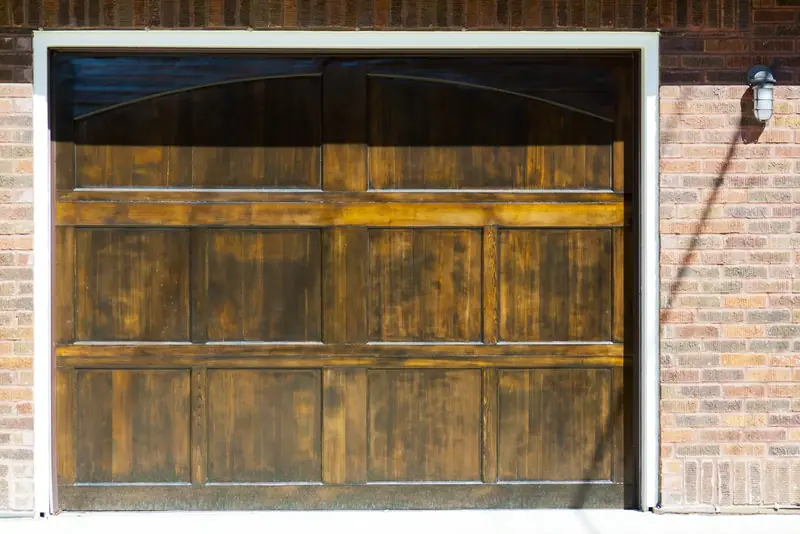
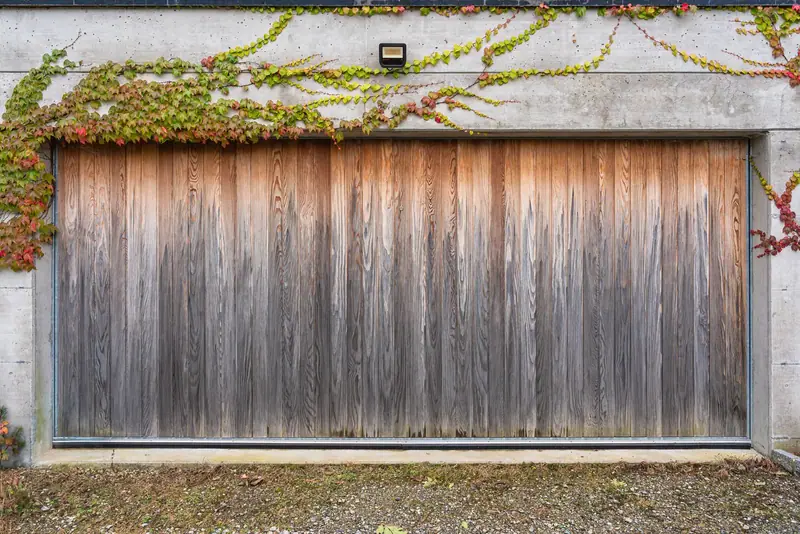
A sun-bleached wood door compared with a freshly finished one
Project notes
The first image shows what happens to an unprotected wood door. The original finish has worn away, ultraviolet light has turned the surface gray, and the boards have dried and begun to check. Left longer, water gets into the end grain at the bottom rail and the joints start to open.
The comparison illustrates a wood door in sound, properly finished condition: clear, even color, crisp panel edges and a film of finish that sheds water. Depending on how far the weathering has gone, getting from one to the other is either a careful refinishing or a new door built in a durable species.
Beyond the obvious improvement in appearance, a sealed wood door stays flatter, keeps its joints tight and weighs less than a waterlogged one, which is easier on the springs and the opener.
Illustrative example. These are licensed reference photographs chosen to show the kind of change this service makes. They are not photos of a specific Nashotah Garage Door customer's property.
Finishing: the part that decides how long it lasts
Wood fails when water gets in and stays in. Everything about finishing is aimed at preventing that.
All six sides. Each section must be sealed on its face, back, both ends, top and bottom edge before installation. Unsealed edges, especially the bottom edge of the lowest section, are where rot begins.
Stain or paint. Semi-transparent stains show the grain and need renewing more often. Solid stains and paints hide the grain and protect longer. A clear finish alone gives the least protection from sunlight and is best kept for sheltered doors.
Ultraviolet protection. Sun breaks down both the finish and the wood surface beneath it. Pigmented finishes with UV inhibitors last far longer than clear ones.
Factory or site finishing. Many doors can be ordered pre-finished under controlled conditions, which generally gives the most even and durable result. Others are finished on site to match existing woodwork.
A realistic upkeep schedule
- Every spring, wash the door and look closely at the finish, particularly the bottom rail and any south- or west-facing surface.
- When the sheen dulls or water stops beading, clean, lightly sand and apply a maintenance coat. On an exposed face this may be every one to three years. Under a deep overhang it can be much longer.
- Never let it go to bare wood. A maintenance coat is an afternoon. Stripping and refinishing a grayed door is a major job.
Wood and the Nashotah climate
Our weather tests wood in several ways at once.
Summer humidity swells the boards. Dry, heated winter air on the inside and cold on the outside shrinks them. A well-built door allows for that movement with floating panels and proper joinery, and a good finish slows the moisture exchange so the movement is gradual.
Snow piled against the door and splashback from the driveway keep the bottom rail wet for weeks. We recommend keeping snow cleared from the base, making sure the apron drains away from the door, and paying particular attention to the finish on that lowest section.
Lake air adds constant dampness, and shaded, north-facing or tree-covered garages stay wet longer and can grow mildew. Cedar, mahogany and wood-over-core construction handle these positions best.
Strong western sun is the hardest exposure of all. If that is where your garage faces, consider a pigmented finish, a lighter tone, or an overhang or pergola above the door.
Hardware and installation
Wood doors are heavy. A solid double door can exceed four hundred pounds. That changes everything behind the face.
- Springs are calculated from the true door weight and are often supplied in pairs or sets with a high-cycle rating.
- Track and brackets are heavier gauge, with reinforced fixing to the framing.
- Rollers are long-stem with sealed bearings.
- The opener is selected for the load, usually a belt-drive DC unit with soft start and stop to avoid jolting the joints.
Because weight changes slightly with the seasons as the wood takes on and gives up moisture, we check the balance carefully and recommend an annual maintenance visit so the springs can be trimmed if needed.
The installation itself follows our custom door process: precise measurement, an approved design, careful handling of finished sections, and a final check of reveals and operation.
Why this is specialist work
A wood door is a piece of joinery hung on a counterbalance system carrying several hundred pounds. Under-sized springs or a poorly set opener will rack the door and open its joints. Careless handling will damage a finish that took days to apply. And the springs themselves hold far more energy than those on a light steel door. Experienced installation protects the door, the building and the people around it.
Frequently asked questions
With the finish kept up, decades. Wood doors can also be repaired and refinished in ways steel cannot. Neglected, they can deteriorate in well under ten years.
It depends on exposure and finish type. A stained door in full sun may want a maintenance coat every year or two. A painted or sheltered door goes considerably longer. Inspect it every spring.
Wood-over-core doors have a foam center and insulate well. Solid wood has some natural insulating value, though less than a foam-core door.
We can assess it. If the wood is sound, it can often be restored and individual damaged parts replaced. If the rails are soft or the joints have failed, a new door is the better investment.
Cedar is lighter, less expensive and very stable. Mahogany is harder, denser and more refined in appearance. Both perform well here when properly finished.
Look at steel or composite doors with wood-grain finishes, or a composite overlay door. They come remarkably close and need only washing.