Few garage door problems look as alarming as a door off its track. One side is higher than the other. There is a gap you can see daylight through. Rollers are dangling in mid-air, and the whole thing is wedged in the opening at an angle.
It looks bad because it is. A garage door that has left its tracks is held up by friction and luck. We handle off-track repairs for homeowners across Nashotah and the neighboring communities, and the first thing we will ask you to do is nothing at all.
What to do right now
- Stop using the opener. Unplug it if you can reach the outlet safely.
- Do not pull the emergency release cord if the door is raised. It may drop.
- Do not try to lift, push or pry the door back into the track.
- Keep people, pets and vehicles away from both sides of the door.
- If a car is underneath or beside the door, leave it there until the door has been secured.
- If the opening is unsecured overnight, tell us. We can discuss options for securing it.
The reason for all this caution is weight. A door off its track is often no longer supported evenly by its springs and cables. Moving it can shift the load onto a single cable or a bent roller, and several hundred pounds of door can come down without warning.
How a door ends up off its track
There is always a cause. The door did not simply decide to leave.
A vehicle or object hit the door
The most common reason. Backing into a closed or partly open door bends the track and pops the rollers out.
A lift cable broke or came off its drum
One side loses support, the door tilts, and the rollers on the high side are levered out.
The door closed on something
A bin, a bumper or a snow shovel under one side stops that corner while the other keeps moving.
A spring broke while the door was moving
The sudden loss of lift lets the door drop unevenly.
Worn or broken rollers
A roller that has lost its wheel or bearing no longer stays in the track.
Loose or bent track
Track that has pulled away from the wall, or spread open, lets rollers escape.
The opener kept pushing
A door that was frozen down, locked or obstructed, with the opener still driving it.
Someone forced a stuck door
Pulling hard on one side of a binding door racks it out of the track.
Knowing which of these happened tells us what else to look for.
Why putting the rollers back is not the repair
It is natural to think that if the rollers went out, the fix is to put them back in. People do try, with a pair of pliers to open up the track and a shove on the door.
Here is the trouble with that.
First, the track has almost certainly been bent to let the rollers out. If it is not straightened or replaced, they will come out again at the same spot.
Second, whatever caused the derailment is still there: the frayed cable, the seized roller, the loose bracket.
Third, when a door goes crooked, the cables go slack on one side and usually jump off their drums. The door may look as though it is back in place and actually be hanging from one cable.
And fourth, prying open a track with the door loaded can release the door.
A proper repair deals with the door, the track and the cause together.
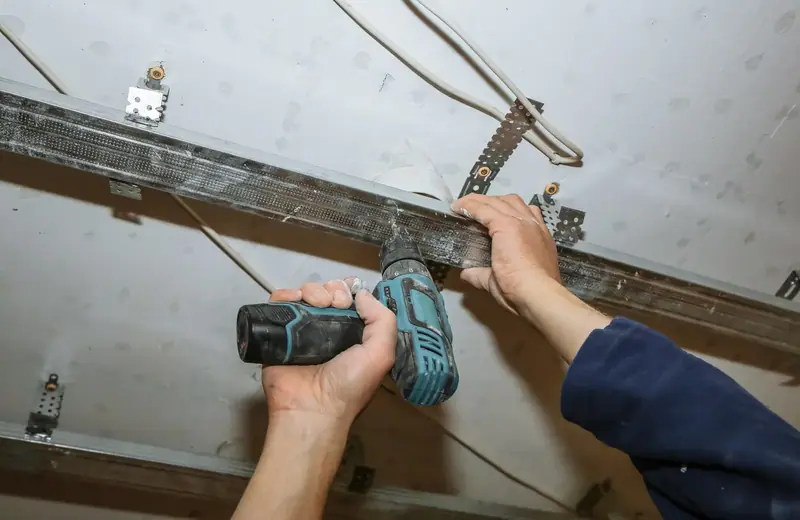
How we repair an off-track door
- 01
Make the scene safe
We assess how the door is sitting and support it with clamps, props or a lift so it cannot move while we work.
- 02
Disconnect the opener
The opener is unplugged and detached from the door so it cannot run.
- 03
Release the spring tension
With the door supported, the springs are unwound under control. This removes the stored energy that makes an off-track door dangerous.
- 04
Free and inspect the door
The door is eased into a stable position, usually fully down, and each section, hinge and roller is examined.
- 05
Repair the track
Bent sections are straightened if the damage is slight and replaced if they are creased. Brackets and hangers are refastened into solid framing.
- 06
Replace damaged hardware
Rollers with bent stems, cracked hinges, frayed cables and damaged drums are replaced.
- 07
Reset rollers and cables
Rollers go back into the track, cables are seated evenly on both drums and the door is leveled.
- 08
Rewind and balance
Springs are wound to specification and the door is balanced by hand.
- 09
Reconnect and test
The opener is reattached, travel and force are reset, the safety reversal is tested, and the door is run several times.
Many off-track doors can be fully repaired in one visit. If a section is badly damaged, we secure the door and return with the part.
Before & after
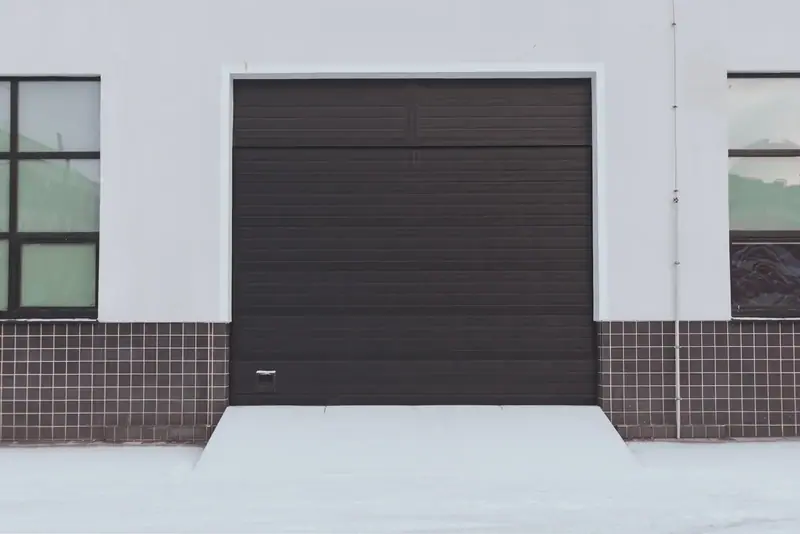
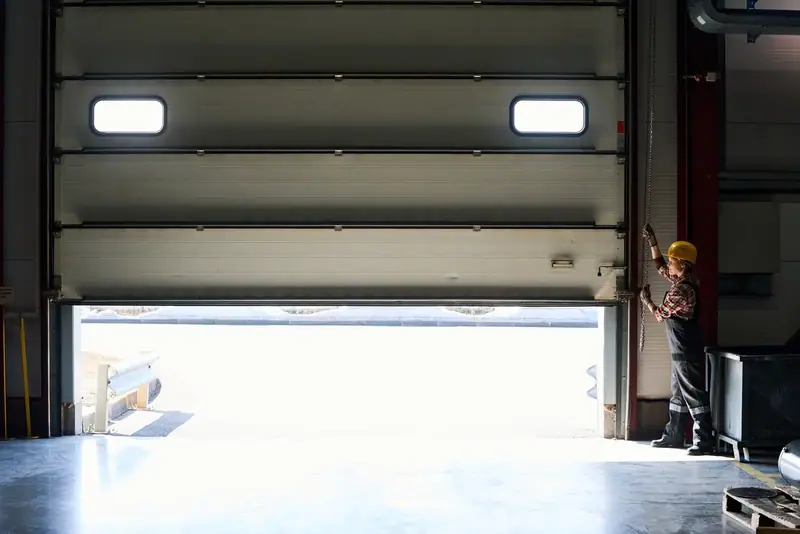
A door stuck partway open compared with one closed flush and secure
Project notes
The first image shows the situation people call us about: the door has stopped partway and will not go up or down. Sometimes it is visibly crooked, with rollers hanging outside the track. Sometimes it simply jams. In both cases the opening is unsecured and the door is not safe to be near.
Putting it right starts with supporting the door so it cannot fall, then releasing the spring tension, guiding the rollers back into the track and replacing anything bent or broken in the process. Track sections, rollers, cables and hinges are all checked.
The comparison shows the end result: the door seated on the floor along its whole width, square in the opening and locked into its tracks. It runs straight, and the cause of the derailment has been dealt with so it does not happen again next week.
Illustrative example. These are licensed reference photographs chosen to show the kind of change this service makes. They are not photos of a specific Nashotah Garage Door customer's property.
Will the door need replacing?
Often not. If the sections are straight and the damage is confined to track, rollers and cables, the door can be put back into service with new hardware.
Replacement comes into the picture when the door itself was damaged in the event. A section that has creased, hinges that have torn out of the steel, or a door that was twisted hard enough to distort several sections may not be worth rebuilding. We will show you the damage and give you both prices. See panel repair & replacement and vehicle impact replacement.
Off-track doors and Wisconsin winters
We see more of these in winter, and the reasons are specific.
Frozen-down doors. The bottom seal freezes to the slab on one side. The opener pulls, the free side lifts, the frozen side does not, and the door racks out of the track. If the door does not move normally on a freezing morning, release the opener and free the seal before trying again.
Snow and ice under the door. A ridge of packed snow or ice under one corner acts like any other obstruction on the way down.
Brittle rollers. Cheap plastic rollers crack in deep cold, and a roller without a wheel leaves the track easily.
Springs that break in the cold. A spring failure mid-travel is a classic cause of a dropped, crooked door.
Slippery driveways. Sliding into the garage door, gently, at two miles an hour, is a Wisconsin tradition nobody wants to keep.
A fall tune-up that checks rollers, cables, track fasteners and balance removes most of the mechanical causes before winter starts.
How to reduce the chance of it happening
- Keep the area under and beside the door clear, including the track bases.
- Never run the opener against a door that will not move. Find out why first.
- Test the opener's safety reversal monthly, so it stops when the door meets something.
- Have worn rollers and frayed cables replaced when they are first noticed.
- Check that the photo-eyes are aligned and working, so the door will not close on an object.
- Make sure the manual lock is not engaged when using the opener.
- Have track fasteners and rear hangers checked each year.
Why this is not a do-it-yourself repair
An off-track door combines every hazard a garage door has. It is heavy, unbalanced, under spring tension and resting on damaged parts. The cables may be under uneven load. The track that normally contains the door is the thing that has failed.
We bring the equipment to support the door, the tools to release the springs safely and the parts to rebuild what is damaged. We also bring the experience to read how the door is sitting before touching it, which is the most important part of the job.
Frequently asked questions
No. Leave it exactly where it is. Moving it can cause it to fall or do further damage.
Commonly one to two hours, depending on how much track and hardware has to be replaced.
Usually not. If the sections are undamaged, new track, rollers and cables will put the door right. Creased or twisted sections change that.
It may be an early stage. A door that hangs unevenly often has a cable problem and can come off its track on the next cycle. Have it checked before using it.
Yes. If it kept running against a jammed door, the gear, trolley or rail can be damaged. We inspect the opener as part of the repair.
Call and tell us. Getting the opening secured is the priority, and we will advise on what can be done straight away.