If your garage door announces itself with a grinding rumble every time it moves, the rollers are the first place to look. They are small, inexpensive parts that do an enormous amount of work, and most doors still have the basic ones they were built with.
We replace garage door rollers throughout Nashotah and the surrounding communities. It is a modest job that makes an outsized difference.
What rollers do
Each section of the door is connected to its neighbors by hinges. The hinges at the ends of each section, plus brackets at the top and bottom corners, hold a roller. The roller's stem sits loosely in the hinge sleeve, and its wheel rides inside the C-shaped track.
A typical seven-foot door has ten rollers, five per side. An eight-foot door has twelve. As the door opens they travel up the vertical track, around the curve and back along the horizontal track. Every roller makes that journey twice per cycle.
A roller is supposed to roll. The wheel turns on a bearing while the stem stays still. When the bearing wears out or seizes, the wheel stops turning and slides. That is when the noise starts and the track begins to wear.
The main types of roller
| Type | Construction | Noise | Typical life | Comment |
|---|---|---|---|---|
| Plastic, no bearing | Plastic wheel on a steel stem | Moderate, gets worse | Short | Often fitted to builder-grade doors. The first to fail. |
| Steel, no bearing | Stamped steel wheel | Loud | Moderate | Tough and noisy. Needs regular lubrication. |
| Steel with ball bearings | Steel wheel on exposed bearings | Loud when dry | Good | Strong. The bearings need oil and can rust. |
| Nylon with sealed bearings | Nylon tire over a sealed ball-bearing core | Very quiet | Long | Our usual recommendation for homes. |
| Heavy-duty or long-stem | As above, with larger bearings or a 7-inch stem | Quiet | Long | For heavy, wide or double-hinged doors. |
The number of ball bearings in the core is a rough guide to quality. Rollers with ten or more bearings, sealed against dust and moisture, run smoothly for many years with no maintenance beyond an occasional wipe.
How to tell your rollers are worn
- Noise. Grinding, rumbling, squeaking or a rhythmic clunk as the door moves.
- Wobble. A wheel that tilts on its stem instead of sitting square in the track.
- Flat spots or chips. Visible damage to the wheel edge.
- Cracked nylon. Tires that have split or crumbled, especially after a cold winter.
- Rust. Orange staining around the bearing or on the stem.
- Jerky travel. The door shudders or hesitates, most often at the curve.
- Wheels that slide. Mark a wheel with a dab of paint and watch. If the mark does not rotate, the roller has seized.
Worn rollers also show up indirectly: tracks with bright wear lines, hinges that have loosened, and an opener that strains or reverses for no clear reason.
What worn rollers do to the rest of the door
It is worth understanding why a cheap part deserves prompt attention.
A sliding roller creates drag. Drag makes the door heavier to move, so the opener's motor, gear and belt or chain all work harder. The roller wears a groove into the track, and the groove makes the door ride unevenly. The side load loosens hinge screws and fatigues the hinge. In a bad case, a collapsed roller lets the stem pop out of the track altogether, and the door comes off its rails.
Replacing rollers at the first signs of wear protects parts that cost many times as much.
How we replace rollers
- 01
Inspect everything nearby
We check all rollers, the hinges that hold them and the tracks they run in. There is little point fitting new rollers into bent track or cracked hinges.
- 02
Secure the door
The opener is disconnected and the door is clamped so it cannot move while hardware is loose.
- 03
Replace the middle rollers
With the door supported, each hinge is unfastened in turn, the old roller is slid out, the new one goes in and the hinge is refastened.
- 04
Deal with the top rollers
The top brackets are adjusted or removed to swap the rollers, then reset so the top section seals against the header.
- 05
Handle the bottom rollers with care
The bottom brackets are attached to the lift cables and under spring tension. They are only worked on with the tension safely released or controlled.
- 06
Check track alignment
Track spacing is confirmed so the new rollers run without binding or excessive play.
- 07
Lubricate and test
Hinge pivots get a little lubricant, sealed rollers need none, and the door is run by hand and then with the opener.
A full set on a standard door is usually done in under an hour.
Before & after
A worn, rusted wheel compared with new sealed-bearing rollers

Project notes
The first image shows the principle at an exaggerated scale: a steel wheel that has been left to the weather until it is pitted, rough and reluctant to turn. A garage door roller in the same state grinds along the track instead of rolling, and the noise carries through the framing into the house.
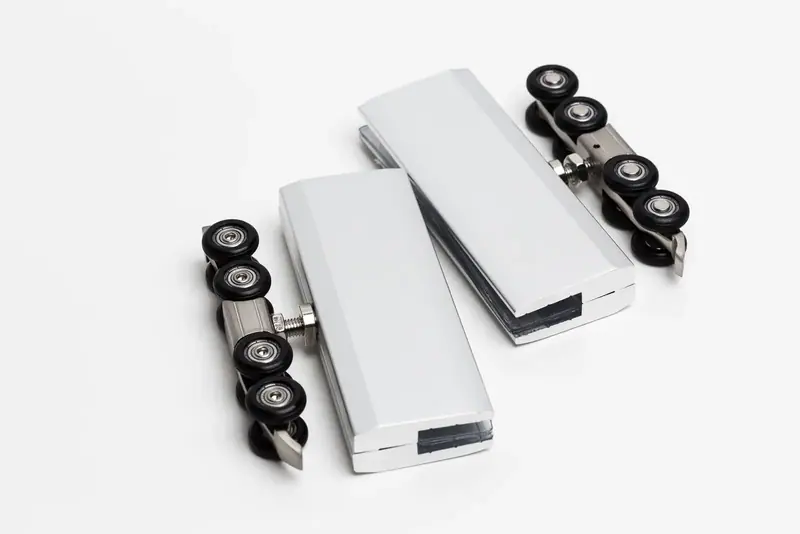
The second image illustrates modern roller assemblies with clean wheels and enclosed ball bearings. On a garage door, the replacement is a full set of nylon-tired rollers with sealed bearings and steel stems sized to the hinges.
The difference is heard before it is seen. The door glides, the opener works less hard, and the tracks stop being worn by wheels that drag.
Illustrative example. These are licensed reference photographs chosen to show the kind of change this service makes. They are not photos of a specific Nashotah Garage Door customer's property.
About those bottom rollers
The two rollers at the bottom corners of the door are different from the rest. Their brackets are also the anchor points for the lift cables, which are pulled tight by the springs. Unbolting a bottom bracket with the springs loaded releases all of that force at once.
This is the reason roller replacement, which looks like a simple do-it-yourself job, sends people to the emergency room. The middle rollers are not especially dangerous. The bottom ones are. We release or control the spring tension before touching them.
Rollers and Wisconsin cold
Nylon and temperature. Cheap plastic rollers turn brittle in deep cold and crack. Quality nylon rollers are formulated to stay tough well below zero, and it is one of the reasons we avoid bargain parts.
Grease that turns to paste. Unsealed bearings packed with ordinary grease stiffen badly in January. The wheels stop turning and start sliding until things warm up. Sealed bearings with low-temperature lubricant do not have this problem.
Salt and grit. The lowest rollers sit in the dirtiest part of the garage. Open steel bearings rust quickly when they are sprayed with road salt all winter. Sealed bearings keep it out.
Thermal movement. Track and door both shrink slightly in the cold. A setup with correct spacing lets the rollers float a little in the track, so they do not bind when the temperature swings forty degrees in a day.
Should you replace all of them?
Usually, yes. Rollers wear at similar rates, and replacing two or three leaves you with a door that is quiet in places and noisy in others. A full set is not expensive, takes little extra time, and means the whole door runs the same.
The exception is a newer door where a single roller has been damaged by an impact. In that case we replace the damaged one and check the rest.
While we are there
Roller replacement is a natural time to look at related hardware.
- Hinges. Cracked or elongated hinges are replaced. See hinge replacement.
- Tracks. Bent or worn sections are straightened or replaced. See track repair.
- Bearings on the shaft. End and center bearings are checked for roughness.
- Lubrication and fasteners. A general tighten and lubricate, as in a tune-up.
If quiet is the main goal, the noise reduction page covers the other contributors, including the opener and how it is mounted.
Why have it done professionally
Apart from the bottom bracket hazard, there are a few reasons. Rollers come in different wheel diameters and stem lengths, and the right ones depend on your track and hinges. A door with wide sections or double end hinges needs long-stem rollers. And the job is an opportunity for a trained eye to check the hinges, track and cables at close range, which is where early problems are spotted.
Frequently asked questions
Plastic rollers may last only a few years. Steel rollers last longer but are noisy. Good nylon rollers with sealed bearings commonly last ten to fifteen years or more.
Almost always. Rollers are the most common source of rumbling and grinding. If the opener or loose hardware is also contributing, we will point that out.
Sealed-bearing nylon rollers do not need lubricating. Do not spray the nylon tire or the track. Unsealed steel rollers benefit from a drop of oil on the bearings twice a year.
The middle rollers can be changed by a careful person. The bottom rollers are attached to brackets under spring tension and should be left to a professional.
Most residential doors use rollers sold as two-inch with a four-inch stem. Heavier or wider doors may need a longer stem. We match them to your door.
Usually ten on a seven-foot door and twelve on an eight-foot door, though it depends on the number of sections.