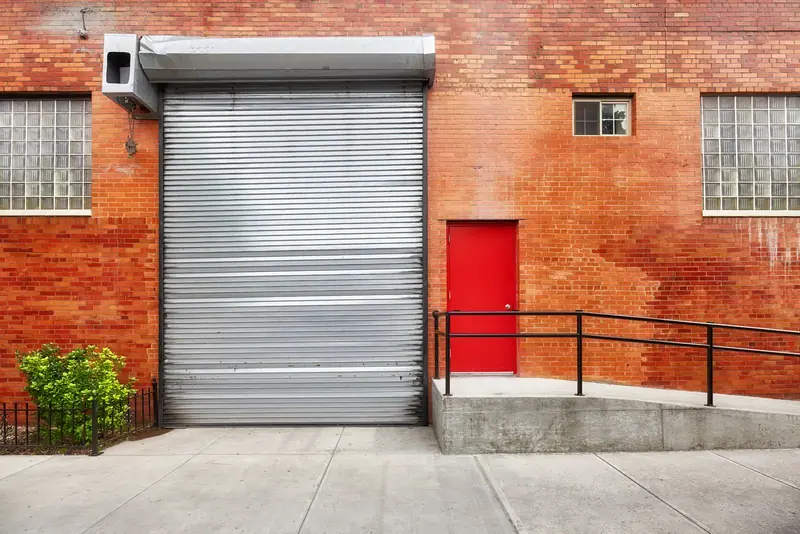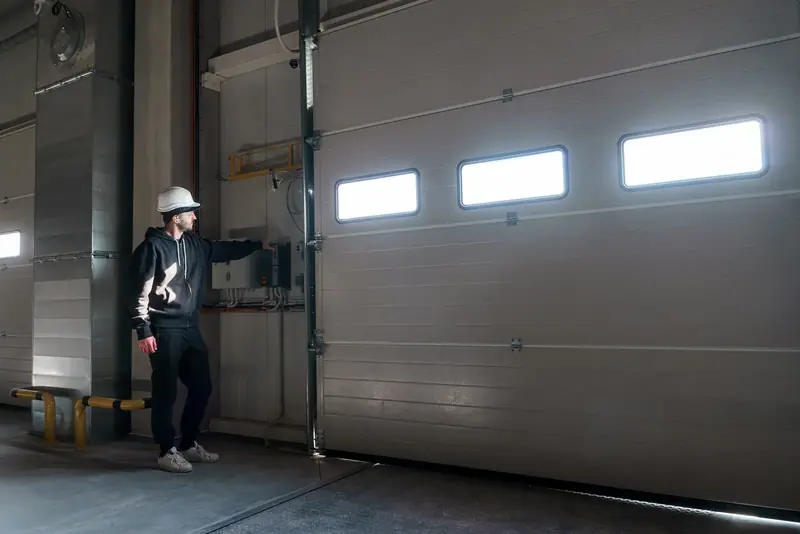
The term “roll-up door” gets used for several things. On this page we mean the light-duty type: a continuous corrugated steel sheet that winds around a drum above the opening. You will find them on self-storage units, garden and machine sheds, pole buildings, small commercial bays and hobby shops.
They are different from heavy rolling steel service doors, which are built from individual interlocking slats. Those are covered on the rolling steel door repair page. We repair both for property owners around Nashotah.
How a sheet roll-up door works
Curtain
A single sheet, or several sheets seamed together, of corrugated steel. It flexes along the corrugations to wrap around the drum.
Drum and axle
A set of drum wheels on a steel axle above the opening. The curtain is fixed to the drums and coils onto them.
Springs
Torsion springs on the axle, usually inside or beside the drum wheels, counterbalance the curtain's weight.
Tensioner
A ratchet or pinned bracket at one end of the axle that allows spring tension to be adjusted.
Guides
Light steel channels at each side. The curtain edges carry felt, nylon or plastic wear strips that run in them.
Bottom bar
A stiffening angle along the lower edge with a rubber seal.
Latch
A slide latch that engages the guide, usually with provision for a padlock.
Lift handles and pull rope
For manual operation.
There are no hinged sections, rollers or tracks running back into the building, which is why these doors suit small units and buildings with limited depth.
The usual complaints
| What you notice | What is usually wrong |
|---|---|
| Door is heavy to lift | Springs have lost tension |
| Door will not stay up, creeps down | Springs have lost tension |
| Door flies up and is hard to pull down | Too much tension |
| Door goes up crooked or jams | Curtain has shifted on the drums, or a guide is bent |
| Scraping or squealing | Wear strips gone, or guides dry or dirty |
| Curtain dented or creased | Impact, often from a vehicle or stored goods shifting |
| Curtain has come out of a guide | Bent guide, wind, or worn edge strips |
| Latch will not engage or slide | Bent latch, misaligned guide slot, or rust |
| Gap under the door | Worn bottom seal or uneven slab |
| Water coming in at the top | Missing or damaged header seal |
Most of these are adjustments and small parts.
Spring tension
By far the most common call. The springs lose a little tension every year. Because the change is gradual, people adapt, until one day the door is simply too heavy or will not stay open. Re-tensioning restores the balance. If a spring has broken, or the door has been re-tensioned many times, the spring or the axle assembly is replaced.
Curtain damage
Small dents are cosmetic. A crease running across the corrugations is different. It creates a stiff line that will not wrap smoothly around the drum, and the curtain will catch there. Depending on the door, a damaged panel can be replaced or the whole curtain renewed on the existing axle.
Guides and wear strips
The strips on the curtain edges keep steel from rubbing on steel. Once they wear through, the door becomes noisy and stiff, and the paint is scraped from the curtain edges. Replacing them is inexpensive.
How we repair a roll-up door
- 01
Assess the door and the opening
We check the curtain, guides, bottom bar, latch, axle, brackets and how the door is fixed to the building.
- 02
Secure the door
The curtain is clamped or pinned so the axle cannot spin while the tension is being worked on.
- 03
Correct the tension
Using the tensioner, spring tension is added or released in controlled steps until the door balances.
- 04
Realign the curtain
If the curtain has walked to one side, it is reset square on the drums.
- 05
Service the guides
Guides are straightened, cleaned and lubricated with a dry or silicone product. Worn edge strips are replaced.
- 06
Repair the bottom bar and seal
A bent bar is straightened or replaced, and a new seal is fitted.
- 07
Repair the latch
Latches are freed, replaced or realigned so they engage fully.
- 08
Test
The door is run through its full travel several times, checked at mid-height for balance and confirmed to latch.
For a single door in fair condition this is often under an hour. For a row of storage units, we can work through them in sequence and report on each.
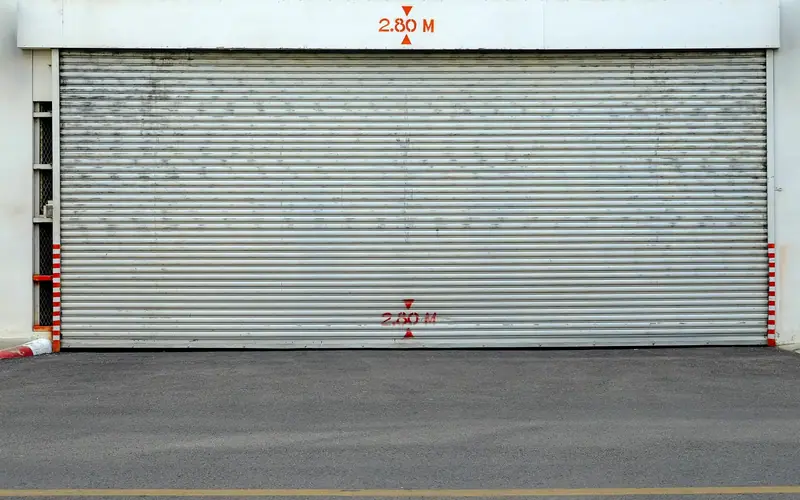
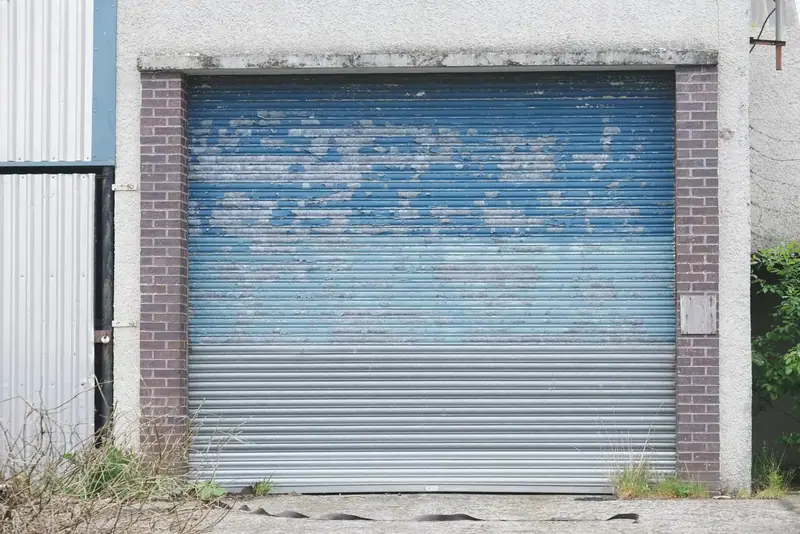
Before & after
A faded, stiff roll-up door compared with clean, working ones

Project notes
The door in the first image has spent years in the sun and weather. Its finish has chalked and faded, and doors in this condition are usually out of tension as well, which is why they feel so heavy and tend to creep down when left open.
The comparison illustrates roll-up doors in good order: even color, straight curtains and bottom bars sitting level on the slab. For a tired door, the route there is to re-tension the springs, clean and lubricate the guides, replace worn guide strips and the bottom seal, repair the latch and, where the sheet itself is damaged or badly faded, replace the curtain.
The practical difference is a door that goes up with one hand, stays where it is put and locks reliably. For a storage or rental building, it also changes how the whole site looks.
Illustrative example. These are licensed reference photographs chosen to show the kind of change this service makes. They are not photos of a specific Nashotah Garage Door customer's property.
Doors by building type
Self-storage
Storage facilities have dozens or hundreds of identical doors, and their condition is a large part of what customers see. Doors that are heavy or will not stay up generate complaints and, occasionally, injuries. A routine of periodic tension checks and lubrication across the site keeps problems down. We can service doors in batches and note any that need curtains or parts.
Farm and equipment buildings
Roll-up doors on machine sheds and shops take dust, chaff and the occasional bump from an implement. Wider doors need more spring and are more sensitive to being out of tension. Wind is a factor on open ground, and wind-rated guides and latches are worth having.
Sheds, boathouses and hobby buildings
Smaller doors on residential outbuildings are common around the lakes. They tend to be used seasonally and then forgotten. Rust on the latch and bottom bar, and springs that have relaxed, are the usual findings.
Small commercial bays
Where a roll-up door is opened many times a day, check whether it is the right door for the job. Light-duty sheet doors are designed for modest use. Heavy traffic may justify a heavier rolling steel or sectional door.
Can a roll-up door be motorized?
Often, yes. Operators made for sheet doors mount at the axle end or beside the drum. The door must be in good condition and correctly tensioned first, and power is needed at the door. For a rarely used shed it is seldom worthwhile. For a shop door used daily, it can be.
Roll-up doors and Wisconsin weather
Cold and tension. Springs give slightly less lift when cold, so a door that was marginal in autumn can become a struggle in January. Tension checks before winter make sense.
Ice in the guides and at the floor. Water runs down the curtain and collects in the bottom of the guides and under the bottom bar, then freezes. Forcing a frozen door can crease the curtain or tear the seal. Clear the ice first.
Condensation. Uninsulated steel sheet sweats on the inside when warm, moist air meets it. In unheated storage this drips onto whatever is stored below. Insulated curtains and good ventilation help.
Salt and rust. The bottom bar and lower corrugations rust first. Galvanized curtains with a baked finish resist this far better than bare painted steel.
Wind. A light sheet curtain can be pushed out of its guides by strong gusts if the guides are shallow or the latch is not engaged. Wind-lock guides and proper latching matter on exposed buildings.
Snow load at the head. Drifting snow against the hood or header can get into the coil. A header seal and a properly fitted hood keep it out.
Simple upkeep
Owners can do a fair amount themselves.
- Wash the curtain once or twice a year. Dirt holds moisture against the paint.
- Keep the guides clear. A blast of air and a wipe with a silicone spray is enough.
- Operate each door periodically, including the ones that are rarely used.
- Lubricate the latch and check that it throws fully.
- Look at the bottom seal for splits and gaps.
Leave the spring tensioner alone unless you have been shown how to use it safely. More on scheduled service on the commercial maintenance page.
Why have a professional do the tensioning
A roll-up door looks unthreatening. The spring inside the axle is still a wound torsion spring, and the tensioner is how its energy is controlled. If the pawl or pin is released without the axle being held, it spins, the tension is lost in an instant, and hands are in the way.
There are also several different tensioning systems in use, some needing specific tools. We work on them regularly, carry the common parts and can tell a door that needs adjusting from one that needs a new spring or curtain.
Frequently asked questions
The springs have lost tension. Re-tensioning usually restores normal operation. If a spring has broken, it must be replaced.
Minor dents can be left or eased out. A crease across the corrugations will keep catching as the door coils, and the panel or curtain should be replaced.
It varies with use, but checking every year or two is reasonable. Heavily used doors need it more often.
A roll-up door uses a continuous corrugated sheet and is light-duty. A rolling steel door is built from individual interlocking slats and is made for heavier commercial use.
Yes. We can work through a site, adjust and lubricate each door and give you a list of any that need parts.
No. Grease collects dirt. Use a silicone spray or dry lubricant, and keep the guides clean.