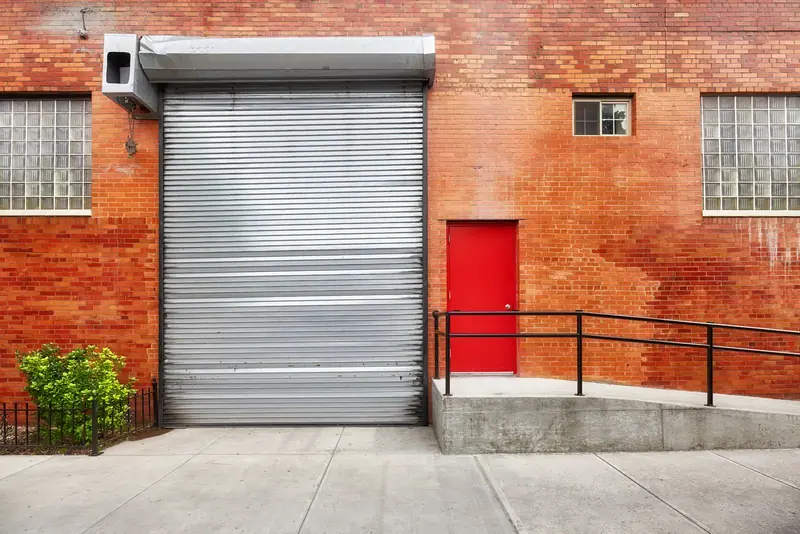
Rolling steel doors turn up wherever space is tight and security matters: loading docks, storefronts, parking structures, industrial units, storage facilities and the back of commercial kitchens. Instead of hinged sections running back along the ceiling, they roll up into a compact coil above the opening.
We repair rolling steel doors for commercial and industrial properties in the Nashotah area. They are robust doors, and when something does go wrong it tends to need more than a general handyman.
How a rolling steel door is built
Curtain
Interlocking horizontal steel slats that form the door face. Each slat hooks into the next and pivots, allowing the curtain to coil.
Endlocks and windlocks
Fittings riveted to the slat ends. Endlocks keep slats from sliding sideways. Windlocks hold the curtain in the guides under wind pressure.
Guides
Vertical steel channels at each jamb that the curtain edges run in.
Barrel
The steel pipe above the opening that the curtain wraps around. It contains the counterbalance springs.
Barrel springs
Torsion springs inside the barrel that offset the weight of the curtain.
Brackets or end plates
Steel plates that support the barrel and carry the operating mechanism.
Hood
The sheet metal cover over the coil.
Bottom bar
A rigid angle or extrusion along the lower edge of the curtain, carrying the bottom seal and often a sensing edge.
Operation
Hand push-up, hand chain, crank or motor operator, depending on size.
Common problems
| Symptom | Likely cause |
|---|---|
| Door will not go up, or is very heavy | Barrel spring has lost tension or broken |
| Door drops or will not stay open | Spring failure, or a brake or chain problem on the operator |
| Curtain jams partway | Bent slat, damaged guide, or misaligned curtain |
| Door runs crooked | Curtain has shifted on the barrel, or endlocks are damaged |
| Scraping, screeching | Curtain rubbing in dry or bent guides |
| Slats have separated or pulled out of the guide | Impact damage, or broken endlocks or windlocks |
| Bottom bar bent | Door closed on an object or struck by a vehicle |
| Motor runs but door does not move | Operator drive, clutch or chain fault |
| Door will not close fully | Limit setting, obstruction in guide, or damaged bottom bar |
Impact damage
The single most common repair. A truck or forklift clips the curtain, bends several slats and pushes them out of the guide. The door then jams. Individual slats can be replaced without renewing the whole curtain, provided matching slats are available for the door's profile.
Spring trouble
The springs are hidden inside the barrel, so their condition is judged by how the door behaves. As they fatigue, the door gets heavier. Many doors have an adjusting wheel at one end plate that allows tension to be added. When adjustment runs out, the spring must be replaced, which is a substantial job.
Guides
Guides get bent by vehicles, packed with debris, or simply go dry. A curtain running in a damaged guide wears its endlocks and can lock up completely.
How we carry out a repair
- 01
Secure the door and lock out power
The curtain is supported so it cannot fall, and any operator is isolated.
- 02
Inspect the full assembly
Curtain, endlocks, guides, bottom bar, hood, brackets, barrel and operating mechanism.
- 03
Identify the slat profile
Slats come in many shapes and gauges. We record the profile so replacements interlock correctly.
- 04
Free a jammed curtain
Carefully, without forcing it, to avoid damaging more slats.
- 05
Replace damaged slats and fittings
The curtain is partly unwound, damaged slats are slid out and new ones fed in, with endlocks and windlocks refitted.
- 06
Repair guides and bottom bar
Guides are straightened or replaced, cleaned and lubricated. A bent bottom bar is replaced along with its seal.
- 07
Set the spring tension
Tension is adjusted so the door is balanced. If the spring has failed, the barrel assembly is serviced or replaced.
- 08
Service the operator
Chain, brake, limits and safety devices are checked.
- 09
Test through full travel
The door is cycled repeatedly and checked for level, smooth running and correct stopping points.
Before & after
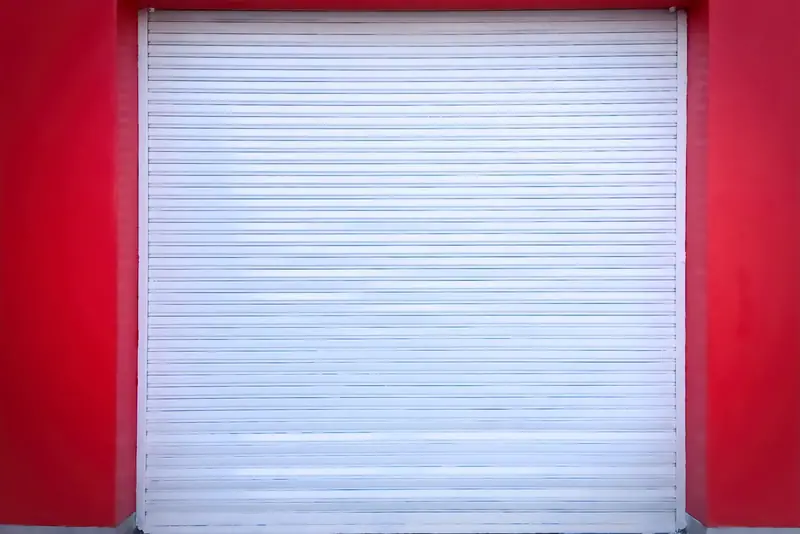
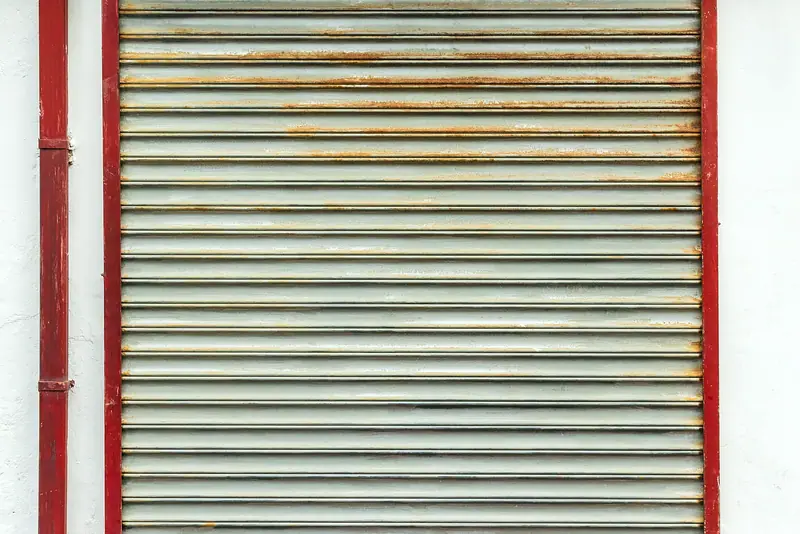
A rusted rolling steel door compared with a clean, serviced one
Project notes
The door in the first image shows what years of weather and no maintenance do to a rolling steel curtain. Rust has spread across the slats, the finish has failed, and a curtain in this state is usually stiff in its guides and reluctant to coil evenly.
The comparison illustrates a rolling door in proper order. Depending on condition, reaching that point involves replacing damaged or corroded slats, straightening or replacing guides, renewing the bottom bar and its seal, adjusting or replacing the barrel spring, and refinishing. Where corrosion has gone too far, the curtain itself is replaced on the existing barrel and guides.
The door then travels freely, sits level on the floor and coils tightly under its hood. For the building owner that means a secure opening that staff can operate without a fight.
Illustrative example. These are licensed reference photographs chosen to show the kind of change this service makes. They are not photos of a specific Nashotah Garage Door customer's property.
Fire-rated rolling doors
Some rolling steel doors are fire doors, installed in fire-rated walls and designed to close automatically when a fusible link melts or an alarm signal is received. They look much like an ordinary service door, but they are life-safety equipment.
Fire doors are subject to specific inspection and drop-testing requirements set out in fire codes, generally on an annual basis, and repairs must preserve the door's rating and labeling. If your building has one, tell us before any work is planned. If a fire door has been propped, tied open or had its release mechanism disabled, it should be corrected promptly.
Repair, re-curtain or replace?
Rolling doors are long-lived, and partial renewal is often possible.
- Repair when damage is limited to a few slats, the guides or the bottom bar, and the barrel and springs are sound.
- Re-curtain when the curtain is widely corroded or damaged and the barrel, brackets and guides are still good.
- Replace when the whole assembly is corroded, the springs have failed in an old barrel, slats for that profile are unobtainable, or the door no longer suits the opening's use.
We will give you the options with prices. In some cases a sectional overhead door is a better fit for the way the opening is used, and we will say so. See overhead door installation.
Rolling steel doors and Wisconsin weather
Corrosion. Uninsulated steel curtains exposed to road salt and wet weather rust at the slat joints, where water sits. Galvanized and factory-finished curtains last far longer than painted bare steel. Washing down the lower slats in spring helps.
Freezing. Water in the guides or along the bottom bar freezes and locks the door. An operator forcing a frozen curtain can bend the bottom bar or damage its drive. Keep guides and threshold clear of ice.
Cold and heat loss. A standard rolling steel door has almost no insulating value and leaks air around the guides and hood. Insulated slat doors and perimeter seals are available where a heated space is involved.
Wind. Large rolling doors on exposed walls rely on windlocks to keep the curtain in its guides. Missing or broken windlocks should be replaced before a storm finds them.
Lubrication. Guides, bearings and operator chains need a lubricant that stays effective in the cold.
Maintenance that prevents most repairs
Rolling doors are often ignored precisely because they are so durable. A little attention goes a long way.
- Keep the guides clear of debris and ice.
- Lubricate guides, bearings and chains at regular intervals.
- Check the bottom bar and seal for damage.
- Watch for slats that are bent or no longer interlocking.
- Test the balance. The door should not drop or shoot up.
- Have springs, operator and safety devices checked on a schedule.
See commercial maintenance for scheduled service.
Why this is specialist work
The counterbalance spring in a rolling door barrel is powerful and enclosed, and releasing or adjusting it incorrectly can spin the barrel or drop the curtain. The curtain is heavy and, once out of its guides, awkward and unpredictable. Work is carried out at height above an opening.
Parts are specific as well. Slat profiles, endlocks and spring assemblies vary by manufacturer and age. Identifying and sourcing the right ones is half the job.
Frequently asked questions
Yes, if slats of the matching profile and gauge can be obtained. The curtain is partly unwound and the damaged slats are exchanged.
The barrel spring has probably lost tension or broken. It may be adjustable, or it may need replacing.
Rolling steel doors are heavy-duty, made of individual interlocking slats. Light-duty roll-up doors use a continuous corrugated sheet. See roll-up door repair.
Often. It depends on the door's size, condition and the space available at the end brackets.
Fire doors carry a rating label, usually on the bottom bar or guide, and have an automatic release mechanism. If you are unsure, we can check.
With maintenance, several decades is common. Springs and operators are replaced along the way.