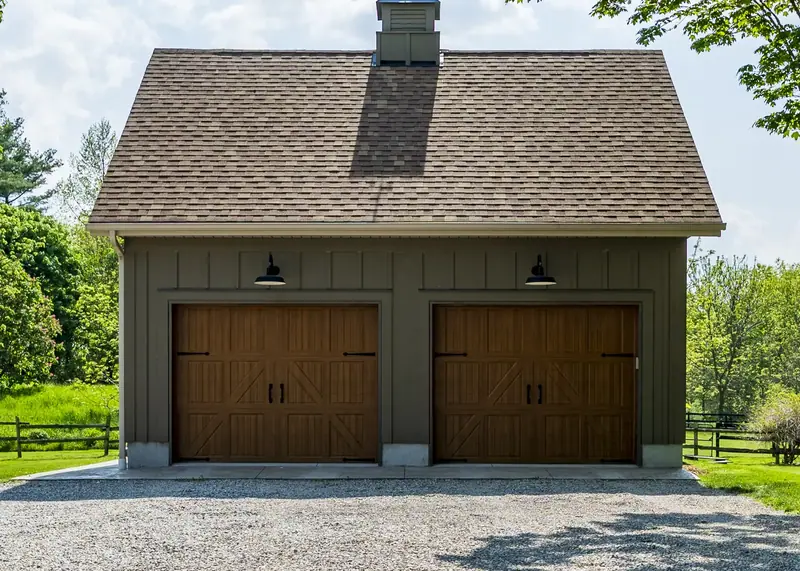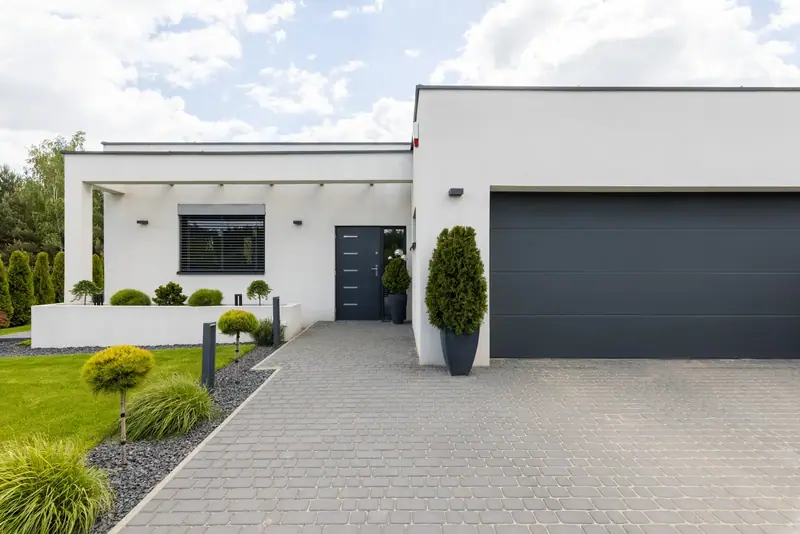
Drive down almost any street in Hartland, Delafield or Nashotah and most of the garage doors you pass are some version of the same idea: rows of rectangular panels, each with a raised center. It is the door people picture when they hear the words “garage door.”
That familiarity is a strength. A traditional door does not fight the architecture, suits nearly every house built in the last sixty years, and is offered in more sizes, colors and constructions than any other style. We install them across the area, and there is more to choosing one well than it first appears.
The traditional family
“Traditional” covers several related panel designs.
Short raised panel
Four panels across a single door, eight across a double, repeated on each section. The most common layout, with a balanced, slightly formal look.
Long raised panel
Two wide panels across a single door, four across a double. Calmer and more horizontal. Suits ranch homes and wider facades.
Recessed panel
The center of each panel sits back instead of standing proud. Often called shaker style. Clean, simple and at home on both older and newer houses.
Flush with grooves
A flat face with shallow lines suggesting panels. A bridge between traditional and modern.
All of them are normally built in steel, with an embossed wood-grain or smooth surface, and are available from single-skin through to fully insulated triple-layer construction.
Why it remains the sensible choice
It suits the housing we have
Much of the housing around Nashotah is colonial, ranch, split-level or two-story traditional. A raised-panel door echoes the paneled entry doors, shutters and window grids those houses already have. It simply belongs.
It is good value
Because these doors are made in huge numbers, you get more door for the money. Budget that would go on styling in another category can go into insulation, better hardware and higher-cycle springs instead.
It hides wear
The embossed texture and the shadow lines of the panels disguise the small dings and marks that every garage door collects. A flat modern door shows every one of them.
Parts stay available
Should a section be damaged years from now, there is a much better chance a matching replacement can be sourced for a mainstream raised-panel door than for a niche design.
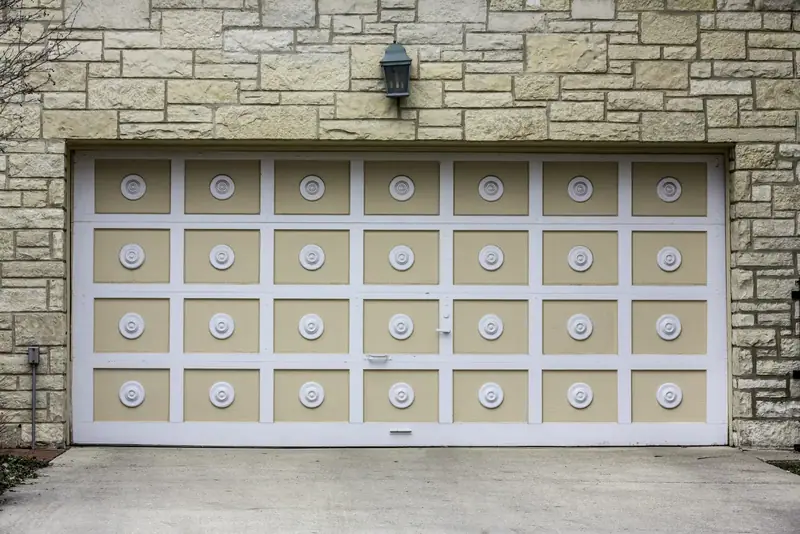
Making a traditional door look considered
The difference between a forgettable door and a good-looking one is usually a few small choices.
Panel proportion. Short panels read as busier and more formal. Long panels are quieter. On a wide, low house, long panels generally sit better. On a tall two-story, short panels keep the door from looking stretched.
Color. White is classic and reflects summer heat. Almond, sandstone and taupe sit comfortably against brick and stone. Darker colors such as charcoal, bronze and deep green look sharp against light siding and are increasingly popular. Matching the door to the trim makes it prominent; matching it to the siding makes it recede.
Texture. Wood-grain embossing is forgiving. A smooth finish looks crisper and suits newer homes, but shows marks sooner.
Windows. A row of glass in the top section, or the second section down for a different look, brings in daylight. Plain rectangular lites are timeless. Grille patterns can echo the house windows. We tend to steer people away from heavily themed inserts that will date the way sunbursts did.
Wood-look finishes. Many traditional doors are offered in printed or stained-look finishes that imitate oak, walnut or cedar. From the road they are convincing, and they need none of the upkeep of real timber.
Choosing the construction
Style is only the face. Behind it, choose the build to suit how the garage is used.
| If your garage is… | We would suggest… |
|---|---|
| Detached, unheated, used for storage | A single- or double-layer door is reasonable |
| Attached to the house | Triple-layer insulated, with section seals |
| Below a bedroom or bonus room | Triple-layer polyurethane and a quiet belt-drive opener |
| Heated or used as a workshop | The highest insulation in your budget, insulated glass |
| Exposed to wind or facing open ground | Triple-layer with added struts on wide doors |
There is more on foam types and R-values on the insulated door page.
It is also worth asking about the hardware package. Nylon ball-bearing rollers, heavier hinges and springs with a higher cycle rating add little to the cost of a new door and a great deal to how it sounds and how long it goes between repairs.
Before & after
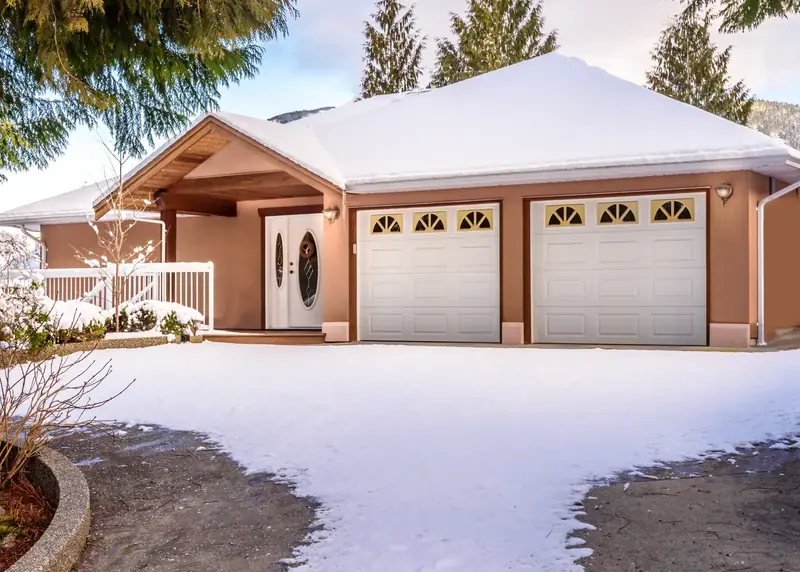
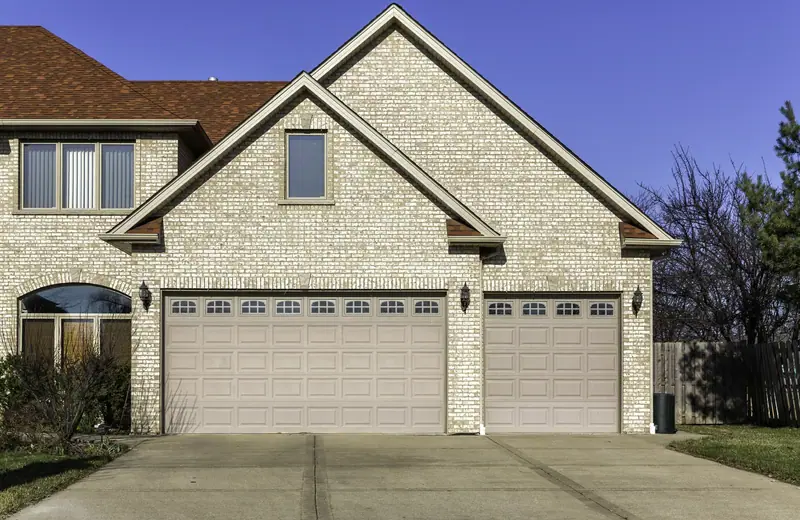
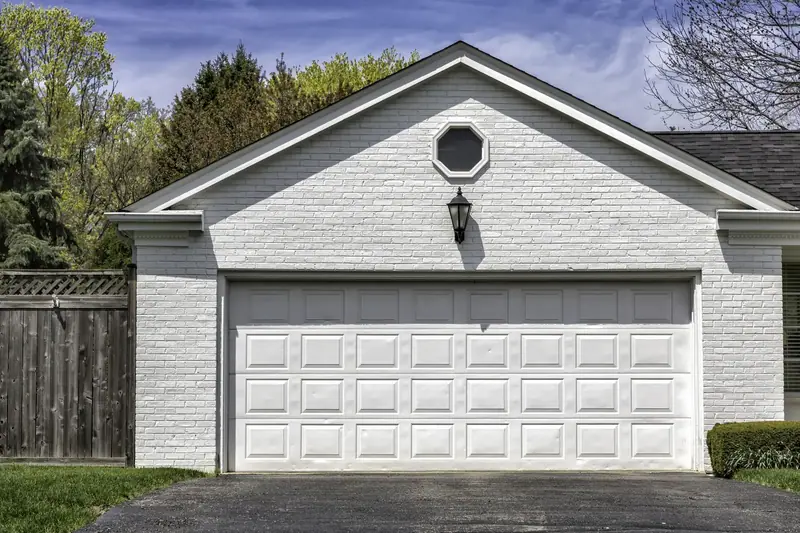
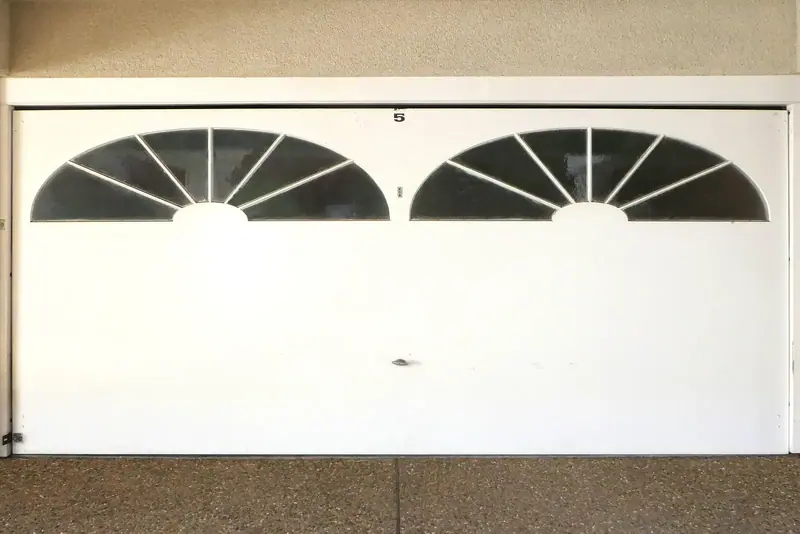
A dated sunburst door replaced with a clean raised-panel design
Project notes
The door in the first image is a style that was everywhere a few decades ago: a flat, wood-composite face with fan-shaped sunburst windows. The surface has scuffed and discolored, the windows have yellowed, and the door has no insulation to speak of.
The illustrated replacement is a traditional raised-panel steel door with an insulated core. The panels are evenly proportioned across the width, the embossed wood-grain texture hides fingerprints and minor marks, and the finish is baked on at the factory. No windows were chosen here, which gives a tidy, private front to the garage.
The change is subtle in the best sense. The garage now recedes politely into the house instead of advertising its age, the door closes with a soft thud instead of a rattle, and the garage behind it holds its warmth.
Illustrative example. These are licensed reference photographs chosen to show the kind of change this service makes. They are not photos of a specific Nashotah Garage Door customer's property.
Built for Wisconsin conditions
Traditional steel doors handle our climate well, provided a few things are right.
The steel should be galvanized under the paint, and the finish should be factory baked. That combination resists the road salt that gets carried into every garage from November to April. Even so, the bottom section takes the brunt, and rinsing it down in spring is the single best thing you can do for the door's appearance.
Section joints should be sealed. On a cheap door the joints between panels are a line of small air leaks. Better doors have a tongue-and-groove joint with a gasket, which matters on a windy January night.
The bottom seal should suit your floor. Frost moves slabs, and a seal with a generous bulb takes up the difference where a thin one leaves a gap for snowmelt and mice.
Finally, the springs and opener should be set for cold operation. Steel stiffens and lubricant thickens as the temperature drops, so we leave a sensible margin in the opener's force setting and use a lubricant that stays fluid well below zero.
Installation and what it involves
A traditional door installs in the standard sequence described on our garage door installation page: measure, prepare the opening, set the track, stack the sections, fit and wind the springs, seal the perimeter and test.
If it is a replacement, the old door, track and springs come out first and are taken away. Most single or double doors are completed in one visit. We reconnect your existing opener if it is suitable, or fit a new one if you have chosen to upgrade.
Two things we pay particular attention to on raised-panel doors. First, that the panels line up horizontally across a pair of neighboring doors, which depends on both bottom sections being set to the same height on a floor that may not be level. Second, that the door sits evenly against the stop molding so the shadow lines look uniform from the street.
Caring for a steel raised-panel door
This is about as low-maintenance as a garage door gets.
- Wash it with mild soap and water twice a year. Avoid abrasive cleaners and pressure washers at close range.
- Touch up scratches promptly so bare steel does not rust.
- Have the hardware checked and lubricated yearly. See residential maintenance.
- Replace the bottom seal when it hardens or tears.
A steel door can also be repainted with a good exterior acrylic if you change the trim color down the line.
Why professional installation is worth it
Even the simplest door depends on correct spring tension, plumb track and properly set opener limits. Those are what make it lift easily, close fully and reverse when it meets an obstruction. Springs in particular are wound under high tension and are not a safe do-it-yourself job. Having the door professionally installed also means the opening is assessed properly first, so problems like a rotted jamb or an out-of-level header are fixed instead of hidden.
Frequently asked questions
On a raised-panel door the center of each rectangle stands slightly forward of its border. On a recessed, or shaker, panel the center sits back. Raised panels look more formal; recessed panels look simpler and cleaner.
Yes, in every level from none to high R-value polyurethane cores. For an attached garage we recommend an insulated triple-layer door.
Yes. Most manufacturers offer browns, grays, black and deep greens. Dark doors absorb more heat on sunny exposures, which is fine for a quality insulated steel door.
Not significantly. The glass is framed into the section, and tempered or insulated options are available. Placing windows in the top section keeps them out of easy reach, and frosted glass protects privacy.
With routine care, decades. Springs, rollers and seals are replaced along the way as normal wear items.
Often, if the model is still in production. That is one of the practical advantages of choosing a mainstream design. See panel repair & replacement.