Most garage door trouble starts small. A new squeak, a slight hesitation halfway up, a door that needs a second press of the button on cold mornings. Because the door still works, it gets ignored, and a few weeks later it stops working on the one day you are already late.
We repair residential garage doors throughout Nashotah and the neighboring lake communities, and our view is simple: a repair is only finished when we know why the part failed. Swapping a frayed cable without asking what frayed it is how people end up paying for the same repair twice.
What a garage door actually is
It helps to picture the system before talking about what goes wrong with it. A sectional garage door is four or five hinged panels riding on rollers inside a pair of steel tracks. The door weighs anywhere from about 130 pounds for a light single door to well over 300 for an insulated or wood double door.
You never feel that weight because a spring system carries it. Either a torsion spring wound on a shaft above the opening, or a pair of extension springs stretched along the horizontal tracks. Steel cables run from the bottom corners of the door up to drums or pulleys, and the springs pull on those cables. When everything is right, the door is so well counterbalanced that it will hover at waist height if you let go.
The opener is the last piece, and the least important mechanically. It is a guide and a brake. It was never meant to lift a door that the springs are not carrying.
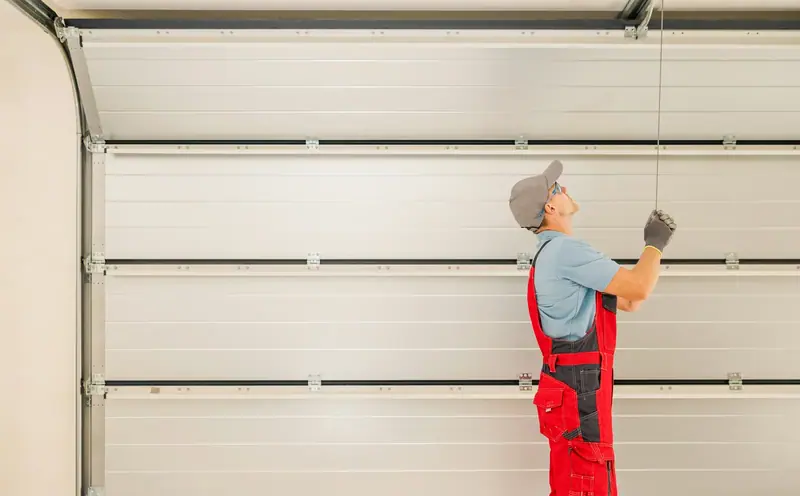
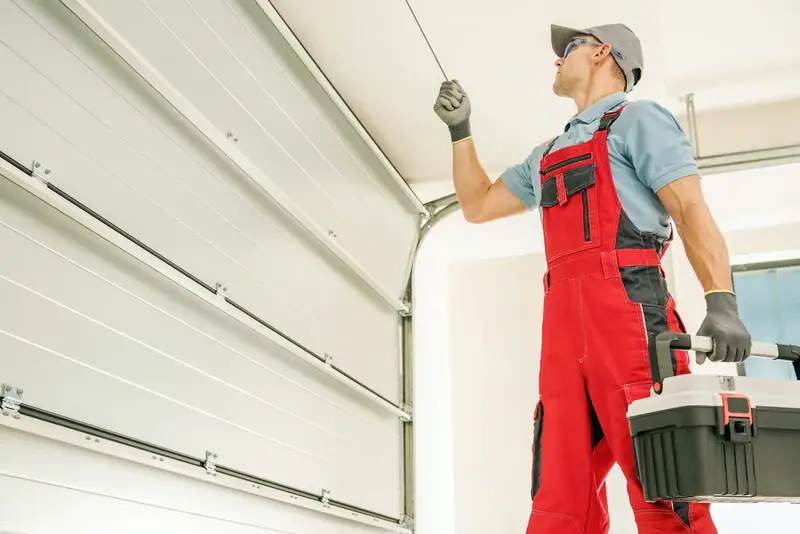
That is why so many “opener problems” turn out to be door problems, and why the first thing we do on any repair call is pull the red release cord and move the door by hand.
Symptoms and what usually causes them
| What you notice | Likely cause | Typical repair | |
|---|---|---|---|
| Door suddenly very heavy or will not lift | Broken torsion or extension spring | [[broken-garage-door-spring-repair | Spring replacement]], rebalance |
| Door hangs lower on one side | Cable off the drum, frayed or snapped | [[garage-door-cable-repair | Cable repair]], drum check |
| Door jammed at an angle in the opening | Rollers out of the track | [[garage-door-off-track-repair | Off-track repair]] |
| Grinding, squealing or popping | Worn rollers, dry hinges, loose hardware | [[garage-door-roller-replacement | Rollers]], lubrication, tightening |
| Starts down then reverses | Sensors blocked or misaligned, or door binding | [[garage-door-sensor-repair-alignment | Sensor alignment]], track adjustment |
| Motor runs, door does not move | Stripped gear or trolley, or the release is disengaged | [[garage-door-opener-repair | Opener repair]] |
| Daylight or drafts at the bottom | Flattened or torn bottom seal, heaved slab | [[garage-door-weather-seal-replacement | New weather seal]] |
A table like this is a starting point. Real doors often have two or three of these going on at once, because one worn part puts extra load on its neighbors.
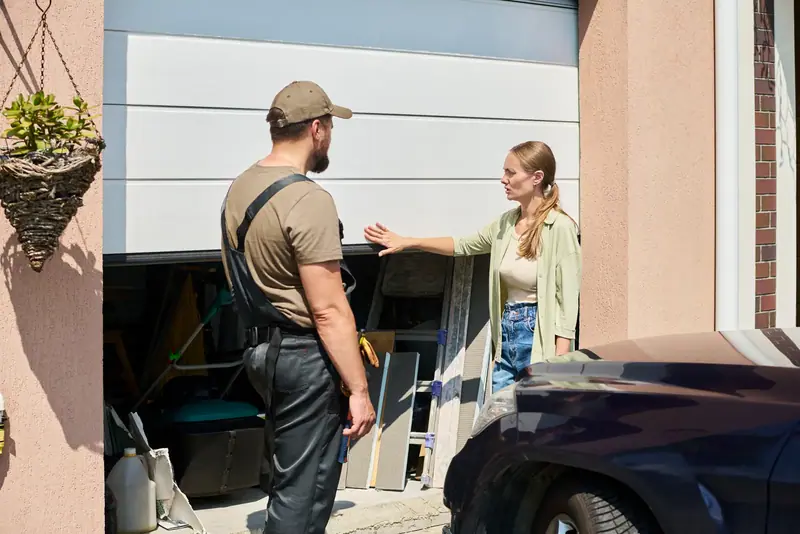
How we approach a repair visit
- 01
Ask before touching
When did it start? Is it worse in the cold? Did anything hit the door? Your answers narrow things down faster than any tool.
- 02
Disconnect and test by hand
With the opener released, we lift the door through its full travel. We feel for weight, binding and rough spots, and check whether it stays put at knee, waist and shoulder height.
- 03
Inspect in order
Springs, cables, drums, bottom brackets, rollers, hinges, tracks, fasteners and seals, then the opener, its rail and its safety sensors. We look at everything, not only the part that failed.
- 04
Show you and price it
You see the worn parts yourself. We explain what must be done now, what can wait, and what each option costs.
- 05
Repair, rebalance and retest
Parts are replaced with the correct size and gauge, the door is balanced, opener travel and force are reset, and the safety reversal is tested before we leave.
Repairs we carry out most often
Springs and cables
Springs wear out by count, not by age. A standard torsion spring is rated for roughly ten thousand cycles, and a household that uses the garage as the main entrance can reach that in six or seven years. Cables last longer but suffer from rust at the bottom bracket, where water and salt sit. Both hold serious tension and are not homeowner repairs. See torsion spring replacement and extension spring replacement for the two spring types.
Rollers, hinges and bearings
These are the wear parts that make noise. Steel rollers without bearings grind in the track; nylon rollers with sealed bearings run close to silent. Hinges crack at the knuckle or pull their fasteners loose from thin steel. Replacing a full set of rollers and any damaged hinges is one of the most satisfying repairs we do, because the difference is obvious the moment the door moves.
Tracks and alignment
Tracks get bumped by cars, bikes and lawn equipment, and the lag screws holding them to the framing work loose over years of vibration. A track that is out by a quarter of an inch can make a door bind, rub or pop out. Minor bends can be straightened and re-anchored. Creased or twisted track is replaced.
Panels and sections
A dented or cracked section does not always mean a new door. If the manufacturer still makes that model, a single section can often be swapped. Stiffening struts can also save a section that has started to bow. Details are on the panel repair page.
Before & after
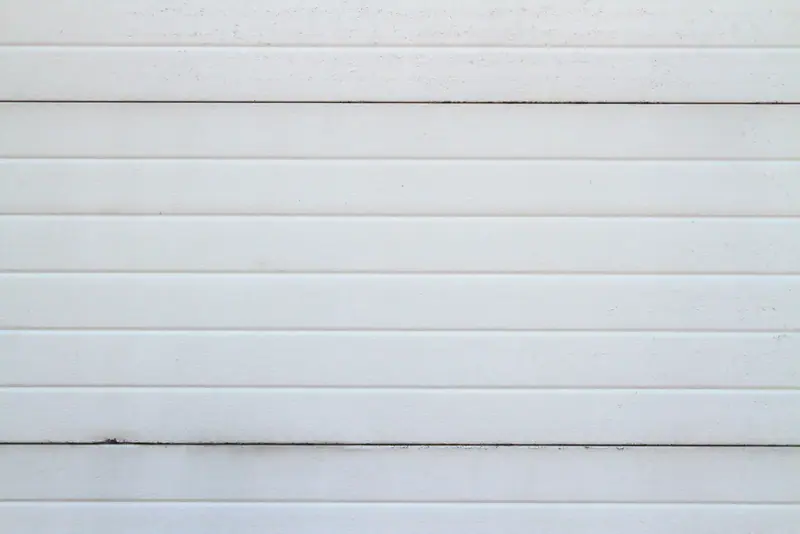
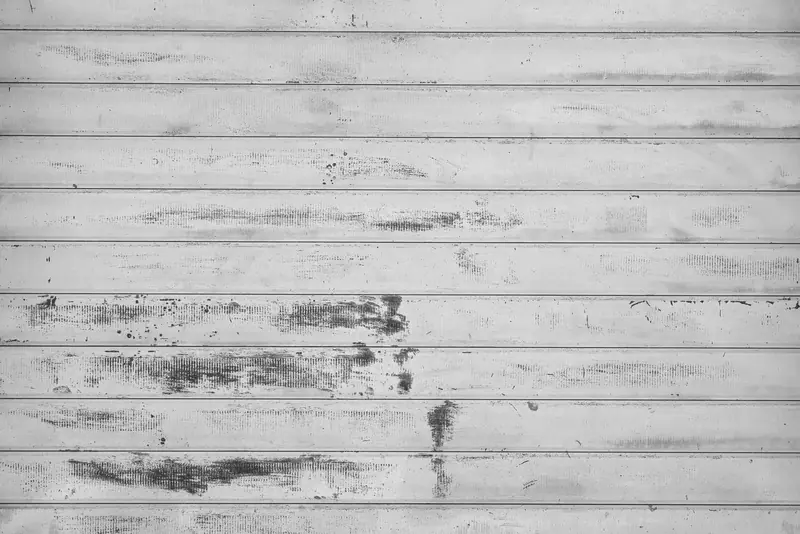
A worn, sticking door brought back to smooth travel
Project notes
This example illustrates a general repair visit on an older steel door. The starting point is a door that still works, more or less, but drags on the way up, rattles at every section joint and leaves a gap at one corner of the floor.
The repair is a combination of small corrections: hinges and track bolts tightened, two cracked hinges and a set of worn rollers replaced, the spring tension corrected so the door balances at mid-height, and the track spacing reset so the sections sit evenly against the stop molding. The face was cleaned and the bottom seal renewed.
Nothing dramatic, and that is the point. The door now lifts with one hand, the opener stops straining, and the seal meets the slab along its full width. Repairs like this add years to a door that would otherwise have been written off.
Illustrative example. These are licensed reference photographs chosen to show the kind of change this service makes. They are not photos of a specific Nashotah Garage Door customer's property.
Cold-weather repairs around Nashotah
A fair share of our winter calls are not breakdowns in the usual sense. They are doors reacting to the cold, and they tend to arrive in clusters after the first real cold snap.
Frozen to the floor
Meltwater runs under the door during the day and freezes the rubber seal to the slab overnight. Do not keep pressing the button. Free it gently with warm water or a plastic scraper, then dry the threshold.
Stiff and slow
Old grease turns to paste below zero. We clean it out and use a lubricant rated for low temperatures on springs, bearings and hinges.
Reversing for no reason
Cold steel and thick lubricant raise the force needed to close. If the opener was set with no margin, it reads this as an obstruction. A balance check and a small force adjustment sort it out.
Sensors in the snow
Photo-eyes sit a few inches off the floor, right where shovelled snow and road spray land. A bump or a film of salt is enough to stop the door closing.
Spring breakage also peaks in winter. Steel is more brittle when cold, and a spring near the end of its life often lets go on the first sub-zero morning. If your door is more than seven or eight years old and has its original springs, autumn is a good time to have them looked at.
Repair or replace?
We lean toward repair. A steel door with a sound frame and straight sections can run for decades with periodic parts. Replacement becomes the sensible choice when:
- The bottom section has rusted through or the steel skin has separated from its frame.
- More than one section is creased, and matching sections are no longer made.
- The door is uninsulated and the garage is now heated or has rooms above it.
- Repair costs are approaching a meaningful share of a new door.
If you are near that line we will lay out both paths with prices and let you decide. The garage door replacement page explains what the second path involves.
Why this is not a weekend project
There is plenty a homeowner can do safely: lubricating hinges, cleaning sensor lenses, tightening the odd loose hinge screw, clearing the tracks of debris. We encourage it.
The line is anything connected to spring tension. That includes the springs themselves, the cables, the drums, the center bearing plate and, less obviously, the bottom brackets at the lower corners of the door. Those brackets look like ordinary hardware, but the cables anchor to them, and removing one with the door closed releases the full force of the spring. Every year people are hurt doing exactly that.
A professional repair also brings the right parts. Springs are specified by wire size, inside diameter and length to suit a particular door weight. A spring that is close but not correct leaves the door heavy or makes it fly up, and either way the opener and the remaining hardware pay for it.
Frequently asked questions
Usually for a short while, but have it checked soon. Noise means metal is wearing against metal somewhere. A popping sound from above the door, or any visible gap in a spring, means stop using it and call.
Look at the two small sensors near the floor on each side of the opening. Both should show a steady light. Clear anything in the way, wipe the lenses and make sure neither has been knocked out of line. If they look fine and the door still will not close, call us.
Yes, if the springs are intact. With the door closed, pull the red release cord and lift from the handle or bottom edge. If it feels extremely heavy, a spring has broken. Leave it down.
Most single-issue repairs, such as a spring pair, a cable, or a set of rollers, are completed in one visit. We will tell you up front if a part has to be ordered.
Yes. We work on the common residential door and opener types regardless of who put them in.
We will. It does not help either of us to spend your money on a door that will need another repair in three months.