Almost every garage door technician's week includes at least one door that has been driven into. From the inside, backing out with the door still down. From the outside, creeping forward on an icy apron. With a bumper, a trailer hitch, a tailgate left open, or a roof box that was not there last month.
There is no need to be embarrassed about it. We replace and repair impact-damaged doors for homeowners in Nashotah and nearby, and the first thing to know is that the door may be less stable than it looks.
What to do straight away
- 01
Stop and switch off
If the vehicle is against or under the door, do not accelerate away. Assess first.
- 02
Do not run the opener
Operating a bent door can pull it off its tracks or bring it down.
- 03
Check whether the door is stable
Look for sections folded or creased, rollers out of the track, bent track and loose cables. If the door is partly open and crooked, keep clear of it.
- 04
Move the vehicle only if it is safe
If the door is resting on the car, or the car is under a raised, damaged door, leave it and call us.
- 05
Keep people away
From both sides of the door.
- 06
Take photographs
Of the door, the vehicle and the point of impact, for your insurer.
- 07
Secure the house
If the garage door cannot close, lock the door between the garage and the house.
- 08
Call us
We will advise on what to do until we arrive.
Why a hit door is dangerous
A garage door is a balanced system. The springs are wound to carry the door's weight through the cables attached at its bottom corners. An impact disturbs all of that at once.
- A crushed bottom section can distort or tear loose the bottom brackets, where the cables are anchored under full spring tension.
- Bent track no longer holds the rollers, so the door can drop out sideways.
- A door pushed out of square leaves one cable slack and the other overloaded.
- Creased sections have lost their stiffness and can fold further without warning.
The door may sit there looking merely dented. Opening it is when things let go.
What typically gets damaged
Door sections
Dents, creases across the width, torn steel, cracked stiles. The bottom two sections take most impacts from vehicles.
Vertical track
Bent or twisted on one or both sides, with brackets pulled from the jamb.
Rollers and hinges
Stems bent, hinges torn from the sections.
Bottom brackets and cables
Distorted brackets, kinked or displaced cables.
Springs and shaft
Shock loads can damage springs or bend a torsion shaft.
Opener
Bent door arm, torn top bracket, stripped drive gear, bent rail.
Jambs and framing
Split jambs, cracked trim, and occasionally movement in the wall framing or header.
Weather seals
Bottom seal torn, side stops broken.
Photo-eyes
Knocked off or broken.
Can it be repaired, or must it be replaced?
It depends on which sections were hit and how badly.
| Damage | Usual outcome |
|---|---|
| Shallow dent, no crease, door runs normally | Cosmetic. Optional repair or strut. |
| One section creased or torn, model still available | Replace that section, plus track and hardware as needed |
| Bottom section crushed, others sound | Replace the bottom section if available. Check brackets and cables closely. |
| Two or more sections creased | Compare with a new door. Often replace. |
| Door twisted or racked through several sections | Replace |
| Discontinued model, or older faded door | Replace. A match is unlikely. |
| Framing or header damaged | Structural repair first, then the door |
We will show you the damage and give you both figures where repair is a realistic option. The panel repair & replacement page covers section replacement in more detail.
Our process
- 01
Make the door safe
We support and secure the door so it cannot move, and disconnect the opener.
- 02
Release the stored energy
Spring tension is let off under control before anything is unbolted.
- 03
Free the vehicle if needed
Once the door is stabilized, a trapped or pinned vehicle can be moved.
- 04
Assess the door and the opening
Sections, track, hardware, springs, opener, jambs, header and framing are all checked.
- 05
Secure the opening
If the door can be closed and locked, we do so. If it cannot, we brace or board the opening as a temporary measure.
- 06
Provide a written estimate
Itemized, with photographs if you need them for an insurance claim.
- 07
Carry out the repair or replacement
Section replacement, or a complete new door with new track and springs.
- 08
Check the opener
Arm, bracket, rail and gear are inspected. Limits and force are reset and the safety reversal tested.
- 09
Final test
Balance, travel and sealing are checked before we leave.
Before & after
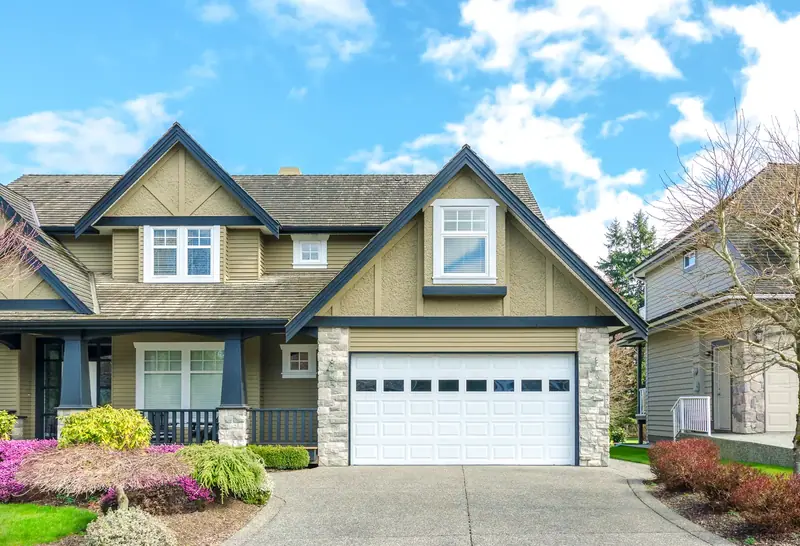
A crushed bottom section compared with a new door on the same kind of garage
Project notes
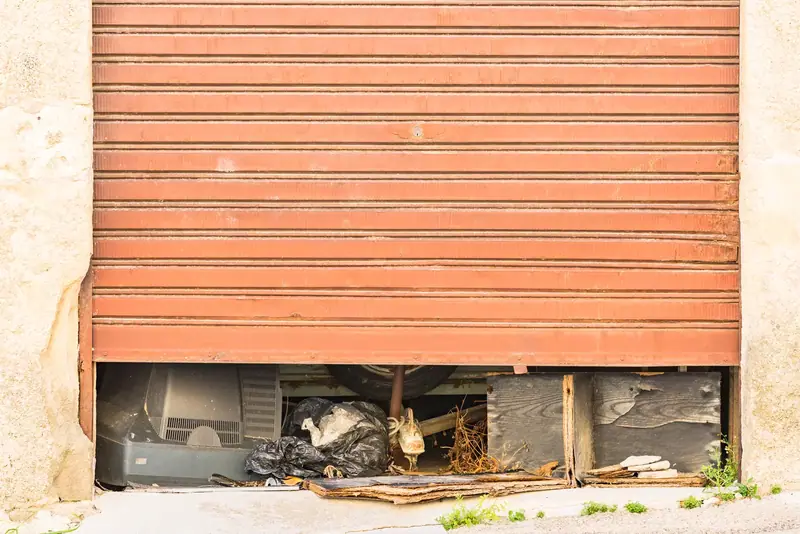
The first image shows unmistakable impact damage. The lower part of the door has been driven inward, the bottom section is crushed and torn, and debris is visible behind it. With damage like this the bottom brackets, cables and lower track are almost always involved as well, and the door is not safe to operate.
A door in this state is replaced, not repaired. The damaged door is taken down under control, the opening and framing are checked for damage from the impact, bent track is renewed, and a new door is installed with new springs and hardware. The opener is inspected and reconnected or replaced.
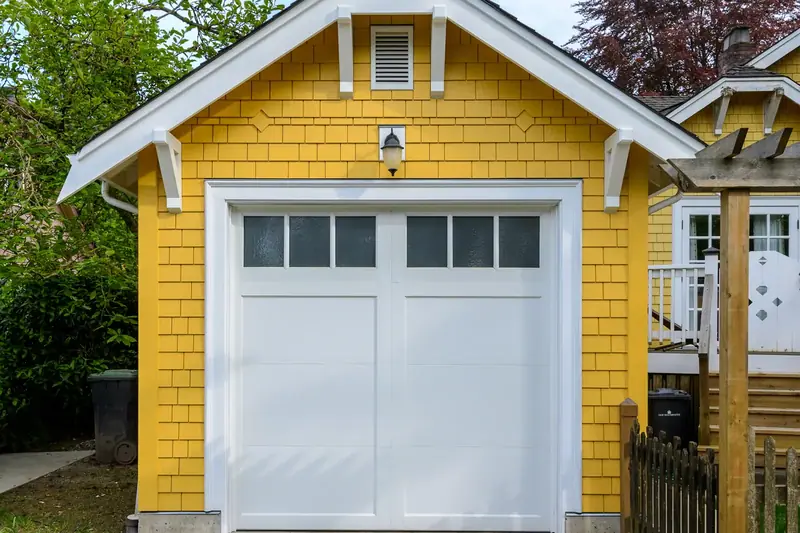
The comparison illustrates the finish: a sound, well-proportioned door, sealed all round and working properly. Many owners take the opportunity to choose an insulated door or add windows, so the garage ends up better than it was before the accident.
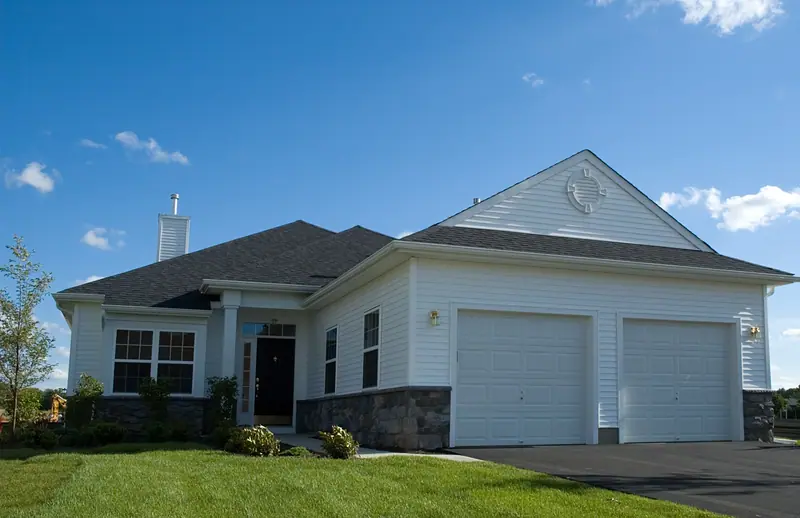
Illustrative example. These are licensed reference photographs chosen to show the kind of change this service makes. They are not photos of a specific Nashotah Garage Door customer's property.
Do not overlook the structure
A garage door opening is framed with a header across the top and trimmer studs at each side. A hard impact, particularly near a jamb, can split a trimmer, crack the header's bearing or shift the wall on its plate. Track fixed to damaged framing will not stay aligned.
Signs of structural involvement include cracks in the drywall or masonry near the opening, a jamb that is visibly out of plumb, a gap that has opened between the trim and the wall, or a header that sags. If we see any of these we will tell you, and recommend that a carpenter or builder puts the framing right before a new door goes in.
If you are replacing, consider upgrading
An unplanned replacement is still a chance to end up with a better door.
- Insulation. If the old door was single-skin steel, an insulated door is warmer, quieter and considerably stronger. See insulated garage doors.
- Style. Carriage house, raised panel or a flush modern design. See carriage house doors and contemporary garage doors.
- Windows. Glass in the top section brings in daylight.
- Hardware. High-cycle springs and nylon rollers for a longer, quieter life.
- Opener. If the opener was damaged or is old, a quiet belt-drive unit with modern safety features is worth considering. See opener replacement.
Insurers typically pay for like-for-like replacement. You can usually pay the difference for an upgrade.
Insurance: a few practical notes
We are not insurance advisers, so check the details with your own company. In general terms:
- Damage to your garage door from your own vehicle is commonly handled under your homeowner's policy, subject to the deductible. Damage to the vehicle falls under auto cover.
- If someone else's vehicle hit your door, their auto liability cover is normally the route.
- Insurers want photographs, a description of what happened and an itemized estimate. We provide the estimate.
- For a single section, the cost may be below your deductible, in which case a claim is not worthwhile.
- Whether a matching section is available can determine whether the claim is for a section or a whole door. We will state this clearly in our estimate.
How it happens around here, and how to avoid it
Ice. A sloped or shaded driveway with a film of ice, and the car slides the last three feet. Keep the apron salted or sanded and approach slowly.
The door did not fully open. In cold weather a stiff door or an opener set close to its limit may stop short. Wait until the door has stopped moving and you can see it is fully up before pulling forward.
Backing out in a hurry. The most common cause of all. The button was pressed and the car was in reverse before the door had cleared.
Roof boxes, racks and lifted trucks. A vehicle that fitted last winter may not fit with a cargo box or ski rack on top.
Trailers and hitches. A hitch ball at bumper height does a neat job on a bottom section.
New drivers. A rite of passage in many households.
Useful habits and aids: pause until the door stops moving, fit a parking guide or hanging marker so you know where to stop inside, keep the backup camera lens clean in winter, and make sure the opener light is working so the door is visible on dark mornings.
Why this is not one to tackle yourself
It is tempting to try pulling a dent or hammering the track straight so the door will at least close. With impact damage, that is where people get hurt. The bottom brackets, cables and springs may be damaged or displaced, and a door that is forced can fall.
A professional makes the door safe first, then determines what can be saved. We also check the things you cannot easily see, such as the shaft, the drums, the opener's drive and the framing, so the new or repaired door is going onto a sound foundation.
Frequently asked questions
Not until it has been checked. Even if it looks only dented, bent track or damaged brackets can cause it to come off its tracks or drop.
Often, if the door model is still made and only one section is creased. With two or more damaged sections, or an older door, replacement is usually better.
Frequently, subject to your policy and deductible. We provide an itemized estimate you can pass to your insurer.
We secure the opening at the first visit. A stock replacement door or section can often be fitted soon after. Special orders take longer.
Yes. Bent arms, torn brackets and stripped gears are common. We inspect and test the opener as part of the job.
Leave it where it is and call us. Moving it could bring the door down. We will stabilize the door first.