In most buildings, the overhead doors are the hardest-working mechanical equipment that nobody is responsible for. The forklift has a service log. The HVAC has a contract. The doors get attention when they stop.
We provide scheduled maintenance for commercial garage doors at businesses, farms and facilities around Nashotah. The aim is modest and worthwhile: fewer surprises.
The case for planned maintenance
Downtime costs more than the repair
When a dock or bay door fails, the repair bill is only part of the cost. There is the delivery that could not unload, the vehicle that could not leave, the staff standing around, and sometimes a building that cannot be secured overnight. Most of that is avoidable.
Wear is predictable
Springs are rated in cycles. If you know roughly how many times a day a door runs, you can estimate when its springs will reach the end of their life and change them beforehand. The same thinking applies to cables, rollers and operator brakes.
Small faults grow
A dry bearing seizes and scores the shaft. A loose track bracket lets the door rub until a roller pops out. A frayed cable strand becomes a snapped cable and a dropped door. Each of those starts as a ten-minute fix.
Safety and liability
A commercial door is heavy equipment operating around employees and visitors. Regular inspection and testing of safety devices, with a record to show it, is part of running a safe site.
Energy
Large doors with failed seals leak heat on a scale that shows up on the gas bill. Seal checks are part of every visit.
What a maintenance visit includes
- 01
Visual and operational check
Each door is run and observed. We note noise, speed, alignment and anything unusual.
- 02
Balance test
With the operator disconnected, the door is checked at several heights. An unbalanced door is corrected or flagged.
- 03
Springs and counterbalance
Springs, shafts, bearings, drums and cables are inspected for wear, corrosion and security.
- 04
Rollers, hinges and track
Rollers are checked for free rotation, hinges for cracks, track for alignment, damage and tight fixings.
- 05
Sections and seals
Sections are examined for damage and rust. Perimeter and bottom seals are checked for contact.
- 06
Lubrication
Bearings, rollers, hinges, springs and operator chains are lubricated with products suited to the temperature range.
- 07
Fasteners
Loose bolts, lags and set screws are tightened.
- 08
Operator service
Brake, clutch, limits, chain tension, controls and wiring condition.
- 09
Safety device tests
Photo-eyes, sensing edges, stop buttons and interlocks are tested for correct function.
- 10
Manual operation
The release and hand chain are tested.
- 11
Report
You receive a summary per door: what was done, what is wearing, what should be planned and anything urgent.
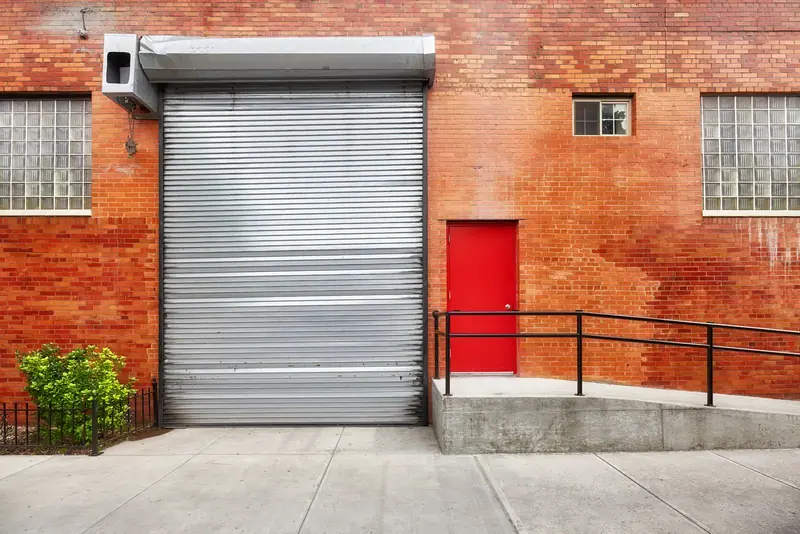
Rolling steel and sheet roll-up doors follow a similar routine adapted to their construction: guides, curtain, bottom bar, barrel tension and hood. See rolling steel door repair and roll-up door repair.
How often?
It depends on how hard the doors work. As a starting point:
| Door usage | Suggested interval |
|---|---|
| Light: a few cycles a day, such as storage or a seldom-used bay | Once a year |
| Moderate: 10 to 25 cycles a day, such as a contractor shop | Twice a year |
| Heavy: 25 to 75 cycles a day, such as a service bay or distribution dock | Quarterly |
| Very heavy or critical openings | Quarterly or more, with spring cycle tracking |
| Fire-rated doors | As required by the applicable fire code, typically an annual inspection and drop test |
In this climate we suggest that at least one visit a year falls in autumn, before the cold.
Tracking spring life
For doors that matter most, we recommend keeping a simple record.
- Note the cycle rating of the springs when they are installed.
- Estimate daily cycles. A count over a typical week is enough, or an operator with a cycle counter will tell you.
- Divide to get an expected life in months.
- Plan replacement at around eighty percent of that figure.
A door with 25,000-cycle springs running forty cycles a day will reach its rating in under two years. Knowing that in advance lets you replace the springs on a quiet afternoon. Choosing a higher cycle rating at the next change stretches the interval.
Before & after
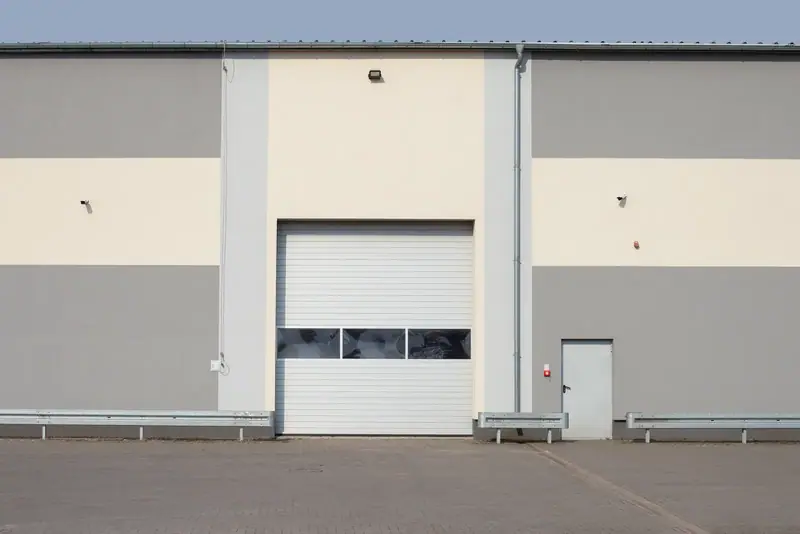
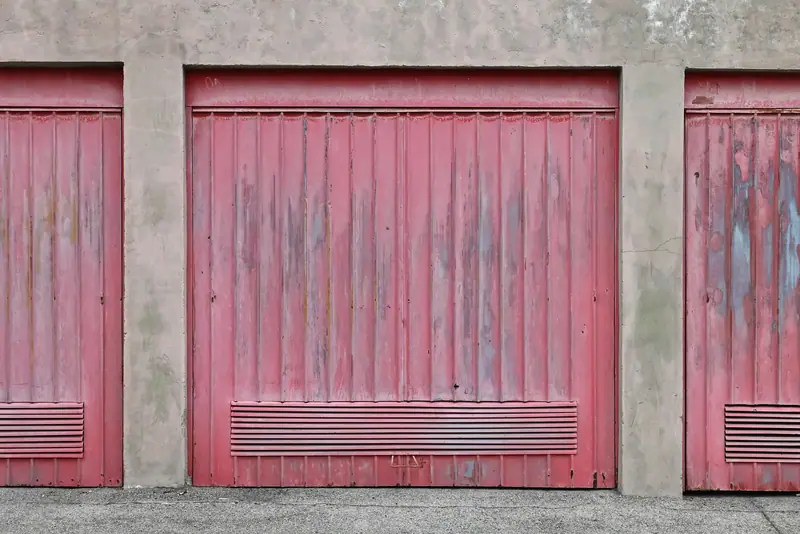
Weathered, neglected doors compared with a maintained one
Project notes
The first image shows a row of doors that have had no attention for a long time. The finish has weathered through, the boards and hardware are tired, and doors like these usually share the same hidden problems: dry bearings, slack cables, springs past their rated life.
The comparison illustrates a commercial door that has been looked after. Its sections are clean and straight, its seals are intact and its pass door closes properly. Nothing exotic produced that result. Hardware was tightened, moving parts were lubricated, worn rollers and seals were replaced as they came due, and the springs were changed before they broke.
For the business, maintained doors mean fewer interruptions, lower repair bills over time, better energy performance and a safer workplace. They also last considerably longer before needing replacement.
Illustrative example. These are licensed reference photographs chosen to show the kind of change this service makes. They are not photos of a specific Nashotah Garage Door customer's property.
What your own staff can do
A maintenance contract works best alongside some basic vigilance on site. We suggest a brief monthly check by a nominated person.
- Run each door and watch and listen. Report anything that has changed.
- Look for frayed cables, gaps in springs, bent track and damaged sections. Do not touch them.
- Test that the door reverses or stops when the photo-eye beam is broken.
- Press the sensing edge by hand while the door closes. The door should stop or reverse.
- Check that the stop button stops the door at every control station.
- Keep the door's path, tracks and threshold clear of pallets, debris and ice.
- Report any impact to the door or track immediately, however minor it seems.
Two rules for staff are worth writing on the wall. Never force a door that is not moving freely. Never walk or drive under a door that is in motion.
Maintenance through a Wisconsin year
Autumn. The key visit. Low-temperature lubricant goes on, seals are checked and replaced before the cold, balance is corrected and springs near the end of their life are changed. Operators are checked for cold-weather running.
Winter. The season of frozen thresholds, stiff doors and salt. Keep thresholds clear. Make sure staff know not to run an operator against a door frozen to the floor. Watch the bottom sections and brackets for corrosion.
Spring. Wash down the lower door, track and brackets to remove salt. Check for frost movement in the slab, which shows as gaps or binding. Inspect anything that took an impact from snow removal equipment.
Summer. Steel expands, and doors adjusted in the cold may run tight. Thunderstorms bring surges, so check operator controls after any electrical event. It is also the best time for painting and larger planned repairs.
Special environments
Agricultural buildings. Dust, chaff, moisture and ammonia are all hard on hardware. More frequent lubrication, corrosion-resistant components and regular cleaning of tracks and guides are needed.
Washdown areas. Car washes, food processing and similar sites need stainless or coated hardware and sealed bearings, and more frequent inspection.
Cold storage. Doors between temperature zones suffer from frost and condensation. Seals and heaters need particular attention.
High-traffic bays. Consider whether impact protection, such as bollards and track guards, would prevent the commonest damage.
What maintenance does not do
It is fair to be clear about the limits. Maintenance will not make a worn-out door new, and it cannot prevent a forklift driving into a track. What it does is catch developing faults, extend the life of components and let you budget for replacements instead of being ambushed by them. When we find a door that is past economic repair, we will say so. See overhead door installation.
Why use a door specialist
General maintenance staff do a great deal well. Commercial doors are a case for a specialist because the important checks involve the counterbalance and the safety systems.
Judging whether a door is balanced, whether a spring is near the end of its life, whether a cable needs changing or a brake needs adjusting comes from seeing many doors. Correcting those things safely requires the right tools and procedures. And a documented inspection by a door company carries weight if anyone ever asks how your equipment has been looked after.
Frequently asked questions
At least once a year for lightly used doors, and two to four times a year for doors in regular or heavy use.
No, but it prevents most of the predictable ones and makes the remainder less likely and less severe.
Yes. We service the common commercial door and operator types regardless of who supplied them.
Yes. After each visit you receive a summary for each door, covering work done, wear noted and anything that needs planning.
Tell us what suits your operation and we will do our best to arrange visits around it.
It depends on the number and type of doors and the service interval. We will provide a clear price after seeing what you have.