The tracks are the least mechanical part of a garage door. They have no bearings, no springs and no motor. They are lengths of formed steel bolted to your garage. And yet a surprising number of door problems come back to them.
We repair, realign and replace garage door tracks for homeowners in Nashotah and the surrounding area. Here is how the track system fits together and what goes wrong with it.
The parts of the track system
Vertical tracks
One on each side of the opening, fixed to the jambs with a series of brackets. They guide the door while it is closed and as it starts to rise.
Curved sections
The radius that carries the rollers from vertical to horizontal. A larger radius gives smoother travel and needs more headroom.
Horizontal tracks
Run back into the garage, level with a slight upward slope toward the rear, and hold the open door.
Jamb brackets
Slotted brackets that fix the vertical track to the wall and allow it to be moved toward or away from the door.
Flag brackets
The plates at the top of each vertical track that join it to the horizontal track and tie into the header.
Rear hangers
Angle iron or strap from the back of the horizontal tracks up to the ceiling framing.
Tracks are sized to the door. Most residential doors use two-inch track. Heavier and commercial doors use three-inch. The steel thickness varies too, and heavier doors need heavier gauge.
What correct alignment means
Four relationships have to be right at the same time.
- Plumb. Each vertical track must be truly vertical, checked with a level.
- Parallel and square. The two tracks must be the same distance apart all the way up and all the way back, and the horizontal tracks must be square to the opening.
- Spacing from the door. The vertical tracks angle very slightly away from the jamb toward the top, so the door pulls tight against the weatherstripping as it closes and frees itself as it opens.
- Level. The horizontal tracks must be level side to side with each other, with a small rise to the back so the open door does not roll forward on its own.
If any of these is out, the rollers bind, the door racks in the opening, or gaps appear along the seals.
How tracks get out of line
- Vehicle contact. A bumper, mirror or trailer catching the vertical track is the most common cause of a bend.
- Loose fasteners. Lag screws back out of the framing after years of vibration, and the track shifts.
- Weak rear hangers. Thin strap hangers flex every time the door stops, and eventually sag or pull out.
- Settling and frost. The building and slab move a little each year, which changes the opening the track was set to.
- Worn rollers. Seized rollers drag along the track and wear or spread it.
- A door coming off track. When a cable snaps or the door is forced, the rollers twist and distort the track on their way out.
- Rust. The bottom few inches of vertical track sit in snowmelt and salt and can corrode through.
Signs of a track problem
Stand inside with the door closed and look, then watch it run.
- Gaps between the rollers and the track, or rollers pressed hard against one side.
- A visible bend, kink or flattened area.
- Shiny rub marks on the track or on the edge of the door.
- The door slows, shudders or bangs at the same point each time.
- Daylight down one side of the closed door.
- Loose or missing bolts, or a track you can move by hand.
- Scraping or screeching in place of the normal rumble.
Repair or replace?
| Condition | What we usually do |
|---|---|
| Track out of plumb or spacing wrong | Loosen brackets, realign, retighten |
| Loose lag screws, sound framing | Refasten, often with larger or longer lags |
| Stripped or split framing | Move the fixing to solid wood or add blocking |
| Gentle bow or slight bend | Straighten carefully and check with a level |
| Sharp kink, crease or twist | Replace that section of track |
| Rusted-through bottom of vertical track | Replace the vertical section |
| Flimsy strap rear hangers | Replace with braced punched angle |
| Track too light for a heavier new door | Replace with the correct gauge |
A crease cannot be reliably straightened. The steel has stretched, and it will always be a weak, rough spot that rollers catch on. Replacing a section is quick and not expensive.
Before & after
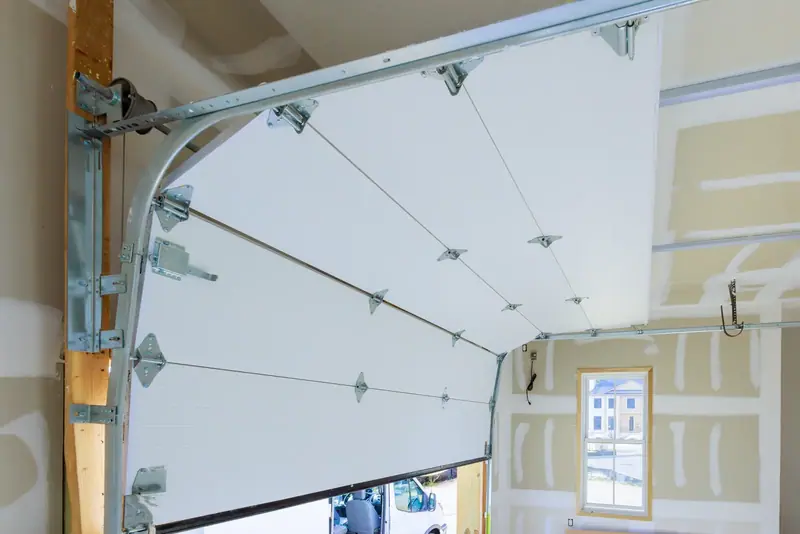
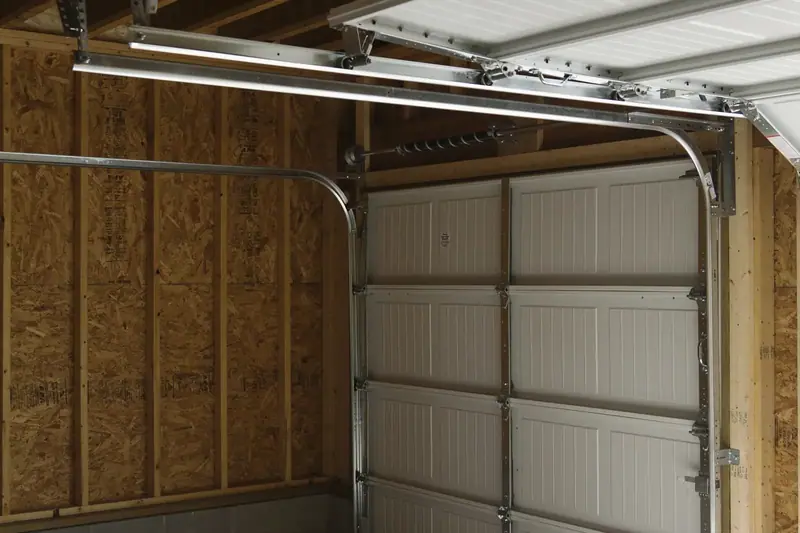
Worn, out-of-line tracks compared with straight, properly set track
Project notes
The first image shows an older installation of the kind we often meet in garages that have been in use for decades: track fastened to aging framing, hangers that have loosened, and wear visible where the rollers have been rubbing. The door still works, though it binds and shakes as it moves.
The comparison illustrates correctly installed track. The vertical sections are plumb and evenly spaced from the door, the curved section meets the horizontal without a step, and the horizontal track is level and braced. Each fastener is into solid framing.
A door on true track moves without scraping or hesitating, closes snugly against its weatherstripping, and is far less likely to leave its rails. The rollers, hinges and opener all last longer because they are no longer fighting the track.
Illustrative example. These are licensed reference photographs chosen to show the kind of change this service makes. They are not photos of a specific Nashotah Garage Door customer's property.
How we carry out a track repair
- 01
Assess the whole door
We look at the tracks, the rollers and hinges that run in them, the cables and the balance. Track damage is often a result of something else.
- 02
Secure the door
The opener is disconnected and the door is clamped or supported so loosening the track cannot let anything shift.
- 03
Check with a level and tape
We measure plumb, track-to-track distance at several points, door-to-track spacing and the level of the horizontals.
- 04
Correct the vertical tracks
Jamb brackets are loosened, the track is set plumb with the right spacing and refastened into solid framing.
- 05
Correct the horizontals
The flag brackets and rear hangers are adjusted so the tracks are level, square and properly supported.
- 06
Replace damaged sections
Any kinked, twisted or corroded track is swapped for new track of the matching size and radius.
- 07
Check rollers and hinges
Rollers that have been damaged by the faulty track are replaced, and hinges are tightened.
- 08
Run and fine-tune
The door is cycled by hand and then with the opener. We watch each roller through its travel and adjust until it is smooth.
A word on lubricating tracks
Do not grease them. It is one of the most common mistakes we see. Grease in the track collects dust and grit, turns into a sticky paste, and makes the rollers slide instead of roll. It gets much worse in the cold.
Tracks should be clean and dry. Wipe them out with a rag now and then. The lubricant belongs on the roller bearings and hinge pivots.
Tracks, frost and Wisconsin garages
Frost heave. Slabs lift and settle with the seasons. In an older garage one side can be noticeably higher than the other by late winter. Because the vertical tracks are fixed to the walls and the door sits on the floor, movement shows up as a gap under one corner or a door that binds. We set the track to the building as it is and choose a bottom seal that can absorb the seasonal change.
Salt and corrosion. The bottom of each vertical track stands in whatever melts off the car. Over ten or fifteen winters it can rust thin. Rinsing the lower track and the floor beside it in spring slows this down a great deal.
Ice in the track. Meltwater can freeze in the base of the vertical track and stop the bottom roller. If the door will not start moving on a freezing morning, look there before you press the button again.
Detached garages. Unheated, lightly built garages rack and shift more with the weather. Their tracks benefit from a check every year or two, and from proper angle hangers at the back.
Why track work is best left to a professional
Track adjustment looks approachable, since it is just loosening and tightening bolts. Two things make it riskier than it appears.
First, the bottom bracket and the bottom of the track are tied into the cable system, and the top of the vertical track joins the flag bracket that supports the spring assembly. Loosening the wrong fastener with the door under tension can release far more than you intended.
Second, track geometry is interdependent. Moving one bracket to cure a rub at the bottom can open a gap at the top or put the horizontal out of square. It takes a methodical approach, proper measuring and usually several small adjustments to bring everything in together. We do it routinely, and we test the result under power before we leave.
Frequently asked questions
A mild bow or a slightly spread section often can. A sharp crease or twist cannot be relied on and should be replaced. We will show you which you have.
The track on that side is probably too close to the door, out of plumb, or the door has shifted sideways because of worn hinges or uneven cables. All are correctable.
It is risky. A roller can jam or escape at the bend, which may bring the door off its tracks. Have it looked at before using it regularly.
No. Keep them clean and dry. Lubricate the roller bearings and hinges instead.
Realignment and refastening is typically under an hour. Replacing a section takes a little longer.
Usually loose fasteners, weak rear hangers, an impact, or seasonal movement in the building or slab. We will tell you what we find so it can be prevented.